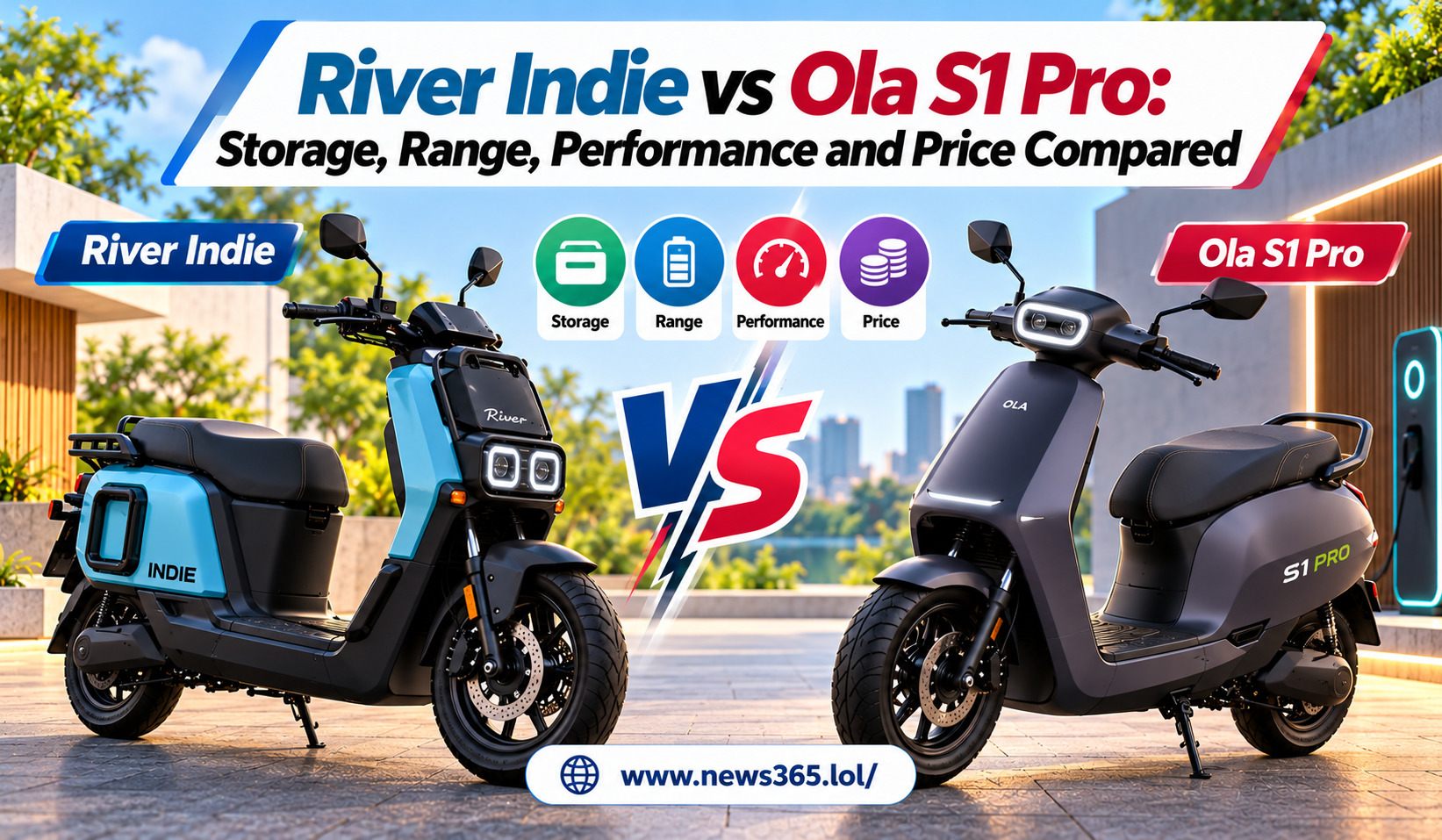
India’s electric scooter market offers different choices for customers who want to reduce fuel expenses and switch to cleaner transportation. Among the interesting options are the River Indie and Ola S1 Pro. Both electric scooters target urban riders, but their design philosophies are quite different.
The River Indie focuses on everyday practicality, with generous storage, a sturdy design and a comfortable riding position. The Ola S1 Pro, on the other hand, targets customers who prefer higher performance, faster acceleration, smart connectivity and multiple battery options.
If you are planning to buy an electric scooter for office travel, shopping, family use or daily commuting, comparing the River Indie vs Ola S1 Pro can help you understand which model offers better value. Let’s look at their prices, battery range, storage capacity, performance and features.
River Indie vs Ola S1 Pro: Price and Variants
Price is an important consideration when purchasing an electric scooter. Both manufacturers offer different advantages, but their pricing and variant strategies are not the same.
The River Indie is available in a standard configuration, with its latest listed average ex-showroom price starting at approximately ₹1.53 lakh. It focuses on practical features rather than offering multiple battery configurations.
The Ola S1 Pro has a wider lineup, including 3 kWh, 4 kWh, S1 Pro Plus 4 kWh and S1 Pro Plus 5.2 kWh versions. Prices start at approximately ₹1.30 lakh and extend to ₹1.75 lakh (ex-showroom), depending on the variant.
The Ola S1 Pro offers a lower starting price, making it attractive to budget-conscious buyers. Its multiple battery options also allow customers to select a scooter according to their commuting requirements.
The River Indie, however, provides a distinctive utility-focused package with a 4 kWh battery and large storage capacity.
Prices may change depending on dealership offers, insurance, registration and location. Buyers should check the latest on-road quotations before making a purchase.
Battery Capacity and Claimed Riding Range
Battery capacity and riding range are important for customers who regularly travel longer distances or want to reduce charging frequency.
The River Indie comes with a 4 kWh lithium-ion battery. It offers a claimed IDC range of 160 km. The company provides three riding modes: Eco, Ride and Rush, allowing riders to adjust performance according to their requirements.
The Ola S1 Pro offers different battery configurations. Its 3 kWh variant has a claimed range of 176 km, while the 4 kWh version provides approximately 242 km. The S1 Pro Plus 4 kWh also offers a claimed range of 242 km, while the top-end 5.2 kWh version delivers up to 320 km.
On paper, the Ola S1 Pro has an advantage in claimed riding range, particularly in its larger battery configurations. However, the River Indie offers a 4 kWh battery with a practical range-oriented setup.
Actual riding distance can vary depending on traffic, riding speed, road conditions, passenger weight, weather and selected riding mode. Buyers should consider real-world range rather than relying entirely on IDC figures.
Storage Capacity: River Indie Has a Practical Advantage
Storage is one of the most important differences between these two electric scooters.
The River Indie has been designed with everyday utility as a major priority. It offers an impressive 43 litres of under-seat storage, making it suitable for carrying shopping bags, helmets and other daily essentials.
It also gets a 12-litre front glovebox, bag hooks, a spacious floorboard and additional luggage-mounting points. These features make the scooter useful for people who regularly carry groceries, office bags or personal belongings.
The Ola S1 Pro offers approximately 34 litres of under-seat storage. This is sufficient for everyday commuting requirements, although it falls short of the River Indie’s storage capacity.
The S1 Pro focuses more on performance and technology than additional luggage space.
For customers who frequently shop, carry bags or need extra storage for household activities, the River Indie has a clear advantage. The Ola S1 Pro remains practical for regular commuting but does not offer the same storage flexibility.
Motor Performance and Top Speed
Performance is another major difference between the River Indie and Ola S1 Pro.
The River Indie uses a mid-drive permanent magnet synchronous motor producing 6.7 kW of peak power and 26 Nm of torque. It has a claimed top speed of 90 kmph and can accelerate from 0 to 40 kmph in approximately 3.7 seconds in Rush mode.
Its three riding modes allow users to balance acceleration and battery consumption. The Rush mode focuses on stronger performance, while Eco mode prioritises efficiency.
The Ola S1 Pro offers stronger performance figures. Depending on the variant, its motor produces up to 13 kW of peak power and 58 Nm of torque. The standard 3 kWh version has a claimed top speed of 117 kmph, while the higher-performance Plus variants offer even greater speeds.
The S1 Pro also provides multiple riding modes, including Eco, Normal and Sport, with Hyper mode available on supported versions.
In terms of acceleration and top speed, the Ola S1 Pro is the stronger performer. The River Indie, however, provides sufficient power for everyday urban journeys and focuses on balanced utility.
Features and Technology Compared
Modern electric scooters offer connected technology, digital displays and convenience features that improve everyday riding.
The River Indie comes with a 6-inch colour display, LED lighting, reverse assistance, regenerative braking and three riding modes. It also offers a USB charging port, parking assistance and smartphone-connected functions such as live location tracking, geofencing and charging status.
Its feature package is relatively straightforward, with greater emphasis on practical usability.
The Ola S1 Pro offers a more technology-focused experience. Depending on the variant, it includes a touchscreen display, Bluetooth connectivity, navigation, GPS tracking, cruise control, reverse mode and over-the-air software updates.
Additional connected features include call and message alerts, ride statistics, remote boot unlocking and vehicle location tracking.
The Ola S1 Pro is a better choice for buyers who prioritise digital features and connected technology. The River Indie is more suitable for people who prefer useful everyday equipment and straightforward functionality.
Comfort, Design and Everyday Practicality
The River Indie features a distinctive design with a wide front apron, practical bodywork and a comfortable seating arrangement. Its 14-inch front and rear wheels provide stability, while the telescopic front suspension and twin rear shock absorbers are designed to handle everyday road conditions.
The scooter also offers a 787 mm seat height and 177 mm ground clearance according to published specifications. Its spacious floorboard and front footpegs provide additional flexibility for different riding positions.
The Ola S1 Pro follows a more modern and sporty design approach. It features a sleek body, compact proportions and a comfortable seating arrangement for urban commuting. Its smaller 12-inch wheels and relatively lightweight construction make it easier to manoeuvre through busy city traffic.
The S1 Pro weighs approximately 109–118 kg, depending on the battery variant, while the River Indie has a kerb weight of approximately 135 kg.
For riders who prioritise a utility-focused design and additional luggage space, the River Indie is an interesting option. Those who prefer a lighter scooter with sporty styling may find the Ola S1 Pro more appealing.
Charging Time and Ownership Experience
Charging convenience is another important factor when selecting an electric scooter.
The River Indie comes with a 4 kWh battery and supports home charging. Its 750W charger can charge the battery from 0 to 80% in approximately five hours, while a complete charge takes around six hours. A 480W charger option is also available, with a longer charging duration.
The Ola S1 Pro offers different charging requirements depending on the battery configuration. The standard versions support home charging, with charging times varying according to the selected battery and charger. The 3 kWh variant takes approximately 6.5 hours for a full charge under the published specifications.
In terms of after-sales support, Ola Electric has an established network of experience centres and service facilities. River Mobility is also expanding its dealership presence across India.
Before purchasing either scooter, check the availability of authorised service centres, battery warranty coverage, spare parts and charging facilities in your city.
Which Electric Scooter Should You Choose?
Choosing between the River Indie and Ola S1 Pro depends on your daily commuting habits and personal preferences.
The River Indie is worth considering if you prioritise storage capacity, practical design and everyday convenience. Its 43-litre under-seat storage, 12-litre glovebox and 4 kWh battery make it particularly suitable for people who regularly carry luggage or shopping bags.
The Ola S1 Pro is a stronger option for customers who want higher performance, faster acceleration, longer claimed range and advanced connected features. Its multiple battery configurations also provide flexibility for different budgets and commuting requirements.
If performance is your main priority, the Ola S1 Pro has an advantage. However, if storage and everyday utility matter more, the River Indie offers a more practical package.
Conclusion
The River Indie vs Ola S1 Pro comparison highlights two electric scooters designed for different types of customers. The River Indie focuses on practicality, storage and comfortable everyday transportation, while the Ola S1 Pro offers stronger performance, higher claimed range and technology-focused features.
The River Indie stands out with its 43-litre under-seat storage, 12-litre glovebox and 160 km claimed range. Meanwhile, the Ola S1 Pro offers up to 320 km of claimed range in its 5.2 kWh Plus variant, along with a higher top speed and more powerful motor.
Ultimately, the right electric scooter depends on your budget, daily travel distance, storage requirements and performance expectations. Compare the latest on-road prices and take test rides before deciding which model suits your everyday needs.