Artificial intelligence is becoming an important part of everyday life. From answering questions and writing emails to creating images and helping businesses manage their work, AI tools are changing how people use technology. However, a new development is taking this technology further. It is called AI agents.
In 2026, AI agents are becoming more useful because they can do more than simply respond to instructions. They can understand a task, make decisions, use different tools, and complete several steps with less human involvement. This makes them different from traditional chatbots, which mainly focus on answering questions and having conversations.
Many people use AI chatbots for writing, research, customer support, and learning. Now, businesses and individuals are exploring AI agents to handle complete tasks instead of doing everything manually. Understanding the difference between these two technologies can help people choose the right tools for their needs.
What Are AI Agents?
AI agents are software systems that can understand a goal and work towards completing it. Instead of waiting for instructions at every step, they can decide what needs to happen next and take suitable actions.
For example, imagine asking an AI agent to prepare a report about a company’s competitors. A traditional chatbot might explain how to research competitors or provide information based on its available knowledge. An AI agent, when connected to suitable tools and information sources, may search for competitors, collect relevant details, compare their services, organise the findings, and prepare a report.
The main difference is that an AI agent can work through multiple steps to achieve a specific result.
AI agents use artificial intelligence to understand instructions and make decisions. Depending on their design, they may also connect with websites, databases, business applications, calendars, email services, and other software.
They do not necessarily work without human involvement. People can provide instructions, review important decisions, and approve actions when required. However, AI agents can reduce the need for constant manual guidance.
How Do AI Agents Work?
AI agents generally begin by understanding the goal provided by a user. They then consider what actions are needed to complete it.
For example, if someone asks an AI agent to organise a business meeting, the system may first understand the meeting requirements. It could then check available calendar information, identify suitable times, prepare an invitation, and ask the user to approve it before sending.
The exact process depends on the tools and permissions available to the agent.
Some AI agents can complete simple tasks in a few seconds, while others may need more time to handle complicated requests. They may also check their progress and change their approach if an earlier action does not produce the expected result.
An important feature of AI agents is their ability to work with external tools. A chatbot may provide instructions about updating a spreadsheet, but an AI agent with spreadsheet access may be able to update the file directly.
However, an AI agent cannot automatically access every application or perform every action. It needs suitable connections, permissions, and instructions.
What Can AI Agents Do in 2026?
AI agents are being used across different industries. Their abilities depend on the software they use, the information available to them, and the level of access provided by users.
1. Automate Everyday Office Tasks
Office employees often spend several hours handling repetitive activities. These may include organising information, preparing documents, updating spreadsheets, sorting emails, and creating reports.
AI agents can help reduce this workload by handling suitable tasks automatically.
For example, an AI agent could collect information from different documents, organise it into a spreadsheet, identify missing details, and prepare a summary for an employee.
This allows people to spend more time on important work instead of repeating the same activities every day.
2. Improve Customer Support
Customer support is another area where AI agents can provide useful assistance.
Traditional customer service chatbots usually answer common questions about products, orders, delivery information, and company policies. More advanced AI agents can do more when they have access to business systems.
For example, an AI agent may check an order, find its current status, update a customer about delivery, and create a support request if something goes wrong.
This can make customer service faster and reduce the pressure on support teams.
However, complicated complaints and sensitive customer issues may still require a human representative.
3. Help With Research and Information Collection
Research often involves visiting different websites, checking information, comparing sources, and preparing useful findings.
AI agents can help complete these activities by collecting information from approved sources and organising it into a useful format.
A business owner could ask an AI agent to research competitors in a particular industry. Depending on its available tools, the agent may collect information about their products, pricing, services, and business activities.
It can then prepare a report that helps the business owner understand the market.
Users should still check important information because AI systems can misunderstand details or provide inaccurate results.
4. Support Marketing Activities
Marketing teams handle many activities, including content planning, audience research, campaign preparation, and performance reporting.
AI agents can support these activities by collecting information, preparing content drafts, organising campaign details, and analysing available marketing data.
For example, an agent could help a marketing team prepare a weekly content calendar based on selected topics. It may also organise social media ideas and prepare draft posts for review.
Some agents can connect with marketing platforms and help manage approved activities.
However, businesses should review content before publishing it to ensure that it matches their brand voice and provides correct information.
5. Manage Data and Prepare Reports
Businesses collect information from sales platforms, customer databases, websites, and other applications. Managing this information manually can take considerable time.
AI agents can help organise data, identify missing information, prepare summaries, and create reports.
For example, a sales team could use an AI agent to review customer records and prepare a summary of pending opportunities. It could also highlight records that need attention.
This can make business information easier to understand and help employees make better decisions.
6. Assist With Software Development
AI agents are also becoming useful in software development.
Developers can use them to understand code, find possible errors, write basic functions, and suggest improvements. More advanced coding agents can work with several files and complete multiple development steps.
For example, a developer may ask an AI agent to create a simple feature for a website. Depending on its permissions and capabilities, the agent could inspect the project, write code, run tests, and suggest changes if an error appears.
Human developers still need to review the code, check security, and make sure the final software works correctly.
What Is a Traditional Chatbot?
A chatbot is a software application designed to communicate with users through text or voice. It receives a question or instruction and provides a response.
Many websites use chatbots to answer customer questions. For example, a shopping website may have a chatbot that explains return policies, provides delivery information, or helps customers find products.
Modern AI chatbots are more advanced than older rule-based systems. They can understand natural language, follow conversations, explain complicated subjects, and generate different types of content.
Tools such as ChatGPT and other AI assistants allow users to ask questions in everyday language instead of following fixed commands.
However, a chatbot’s main purpose is generally communication. It responds to the user’s request, but it may not independently complete an entire process involving several applications and actions.
Some modern chatbots also have tool access and can perform actions. This means the difference between chatbots and AI agents is not always absolute.
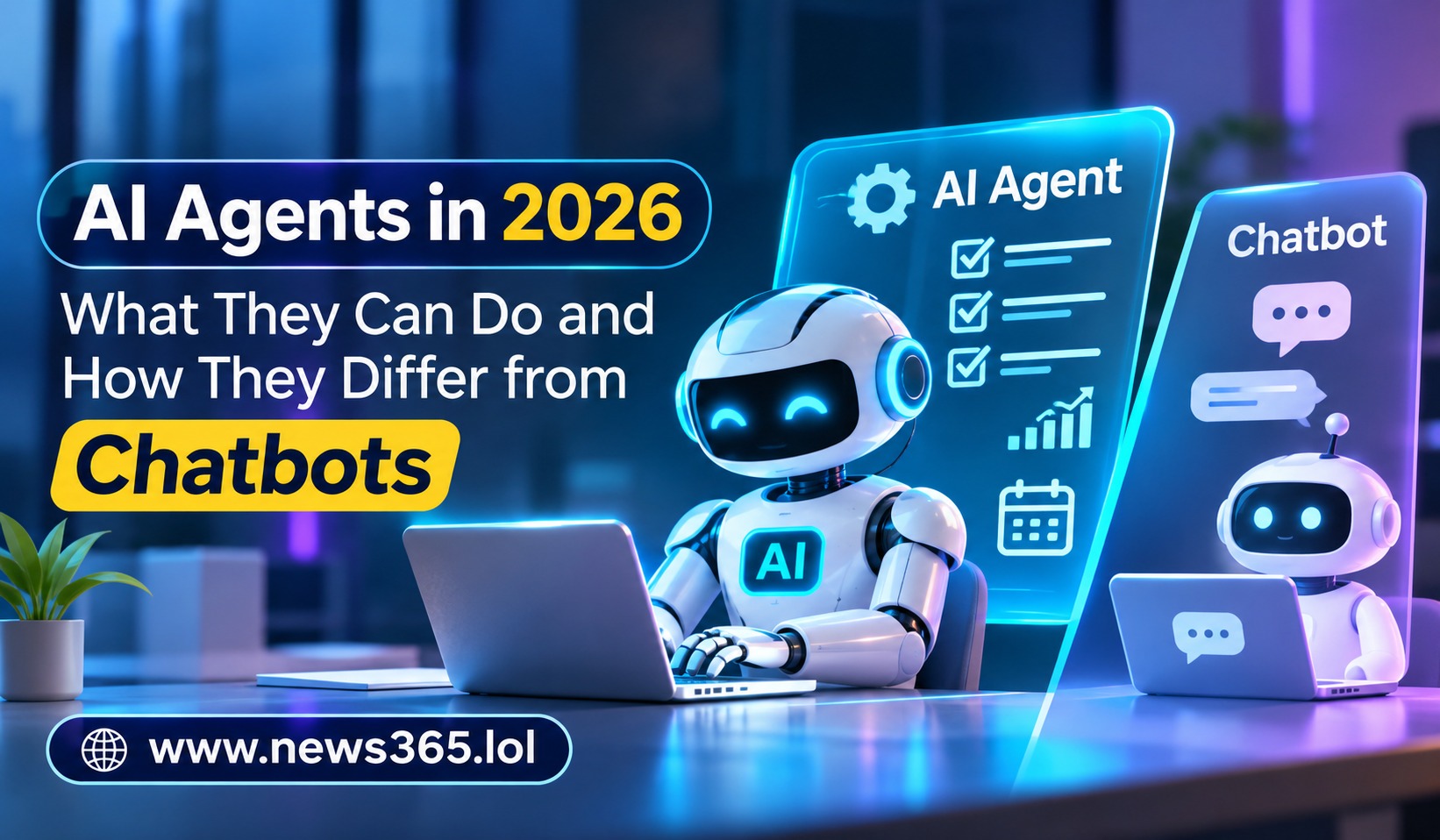
AI Agents vs Chatbots: What Is the Difference?
Although both technologies use artificial intelligence, their main purposes are different.
A traditional chatbot is mainly designed to communicate with people. It answers questions, explains information, and helps users find solutions. An AI agent is designed to work towards completing a goal.
For example, if someone asks how to plan a business trip, a chatbot may explain the planning process and suggest useful considerations. An AI agent with the right tools may help compare travel options, organise the schedule, and prepare a travel plan.
Another difference is how they handle instructions. Chatbots generally respond to individual messages or a continuing conversation. AI agents can break a larger task into smaller steps and work through them.
Their use of external applications can also be different. A basic chatbot may provide instructions for updating a document, while an AI agent with the required access may make the changes itself.
The amount of human involvement also varies. Chatbots usually depend on users to decide what to do after receiving an answer. AI agents can handle several connected activities, although important decisions may still require human approval.
However, it is important to understand that not every chatbot is limited to answering questions. Some modern chatbots have agent-like features, while some AI agents can communicate through a chatbot-style interface.
The difference depends on what the software is designed and permitted to do.
Popular AI Agent Tools to Know in 2026
Several technology companies are developing tools that support agent-based work. These products have different features and are designed for different users.
OpenAI offers agent capabilities through its AI products and development tools. These capabilities can help users research information, work with files, interact with supported websites, and complete multi-step tasks.
Google Gemini also provides agent-related capabilities through its AI ecosystem. Its integration with Google’s services can support tasks involving information, productivity, and connected applications, depending on the available features.
Microsoft Copilot is another important name in this area. It supports workplace activities through Microsoft’s software ecosystem and can help users work with documents, emails, meetings, and business information.
Claude from Anthropic offers AI capabilities that can assist with coding, research, writing, and other complex tasks. Its available tools and integrations can support more advanced workflows.
Zapier also helps businesses connect different applications and automate workflows. Its AI-related features can make it easier to build automated processes without writing large amounts of code.
The availability and capabilities of these tools can change over time. Users should check their current features, pricing, and permissions before selecting one.
Benefits of Using AI Agents
One of the biggest advantages of AI agents is time savings. They can handle repetitive activities and reduce the amount of manual work required to complete everyday tasks.
They can also help businesses improve productivity. Employees can spend more time on planning, communication, creative work, and decision-making while agents handle suitable routine activities.
Another benefit is their ability to connect different steps. Instead of using separate tools for every small activity, an AI agent may bring several connected tasks together.
AI agents can also help businesses provide faster customer support, organise large amounts of information, and maintain more consistent work processes.
For small businesses, this technology may be especially useful because it can reduce the time spent on administrative work without requiring a large team.
However, the benefits depend on choosing the right tasks and setting up the system correctly.
Challenges and Risks of AI Agents
Despite their advantages, AI agents are not perfect. They can misunderstand instructions, make incorrect decisions, or produce information that appears correct but is actually wrong.
This becomes more important when an agent has permission to perform actions. For example, an incorrectly configured agent could update the wrong customer record or send an incomplete message.
Privacy is another important concern. AI agents may work with business documents, customer information, and other private data. Companies must carefully manage what information an agent can access.
Security also matters. Giving an AI agent too much permission can create unnecessary risks. Businesses should provide access only to the applications and information needed for its assigned tasks.
Another challenge is cost. Some advanced AI agent services require paid subscriptions, additional usage fees, or technical setup. Smaller businesses should understand these expenses before adopting them.
Human supervision remains important. AI agents should not be trusted with every decision, particularly when money, legal responsibilities, customer privacy, or important business operations are involved.
How to Choose Between an AI Agent and a Chatbot
The right choice depends on what you want the technology to do.
If your main requirement is answering questions, explaining information, writing content, or supporting website visitors, a chatbot may be enough.
If you want to automate a process involving several steps, connect different applications, organise business information, or complete repetitive work, an AI agent may be more suitable.
For example, an online store may use a chatbot to answer common questions about products and delivery. At the same time, it may use an AI agent to review order information, organise support requests, and prepare internal reports.
Some businesses may benefit from using both technologies together.
Before selecting a solution, consider its features, cost, security, ease of use, and ability to connect with existing software. It is also useful to begin with a small task and check the results before allowing the system to handle more important activities.
The Future of AI Agents Beyond 2026
AI agents are expected to become more capable as artificial intelligence continues to improve. They may become better at understanding complicated instructions, working with different applications, and completing longer tasks.
Businesses may increasingly use agents to support customer service, sales, marketing, research, software development, and everyday office operations.
Another important development is the growth of specialised AI agents. Instead of using one general-purpose system for everything, companies may use different agents for specific responsibilities.
For example, one agent may help manage customer requests, another may prepare sales reports, and another may support employees with internal information.
These agents may also work together when they have suitable connections and permissions.
However, the future of this technology will depend on more than its ability to complete tasks. Accuracy, privacy, security, transparency, and human control will remain important.
Companies that introduce AI agents carefully may find new ways to improve their daily operations without removing the need for human judgement.
Conclusion
AI agents are taking artificial intelligence beyond simple conversations. While traditional chatbots mainly help users ask questions and receive answers, AI agents can work through multiple steps and perform actions to achieve a specific goal.
In 2026, they are becoming useful in office work, customer support, marketing, research, data management, and software development. They can save time and help businesses manage repetitive activities more efficiently.
However, AI agents still have limitations. They need suitable tools, clear instructions, proper permissions, and human supervision to work reliably.
Chatbots and AI agents are not competing technologies. They serve different purposes and can work together. Understanding their differences will help individuals and businesses choose the right solution and make better use of artificial intelligence.
Frequently Asked Questions
1. What is an AI agent in simple words?
An AI agent is a software system that understands a goal, decides which steps are needed, and performs suitable actions to complete a task. It can use connected applications and tools to work with less manual guidance.
2. What is the main difference between AI agents and chatbots?
A chatbot mainly focuses on answering questions and communicating with users. An AI agent can go further by planning tasks, using tools, and completing several connected activities to achieve a specific result.
3. Can AI agents work without human involvement?
AI agents can complete certain tasks independently when they have the required tools and permissions. However, human supervision is still important for checking results and approving sensitive or important actions.
4. Are AI agents useful for small businesses?
Yes, AI agents can help small businesses manage repetitive activities such as organising information, preparing reports, supporting customers, and handling routine office work. They can save time and help employees focus on other responsibilities.
5. Will AI agents replace traditional chatbots?
AI agents are unlikely to make traditional chatbots completely unnecessary. Chatbots remain useful for answering questions and communicating with customers, while AI agents are better suited to completing multi-step tasks. Both technologies can work together to improve business operations.