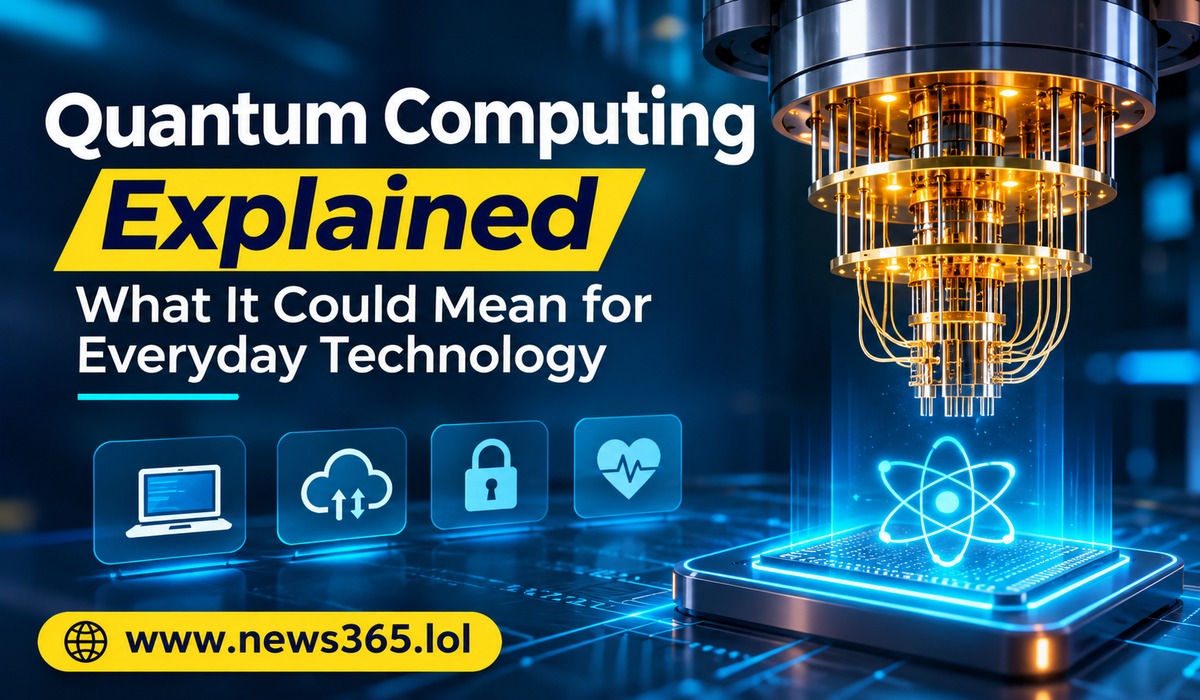
Technology is changing the way people work, communicate, shop, travel, and manage their daily lives. From smartphones and artificial intelligence to online banking and smart home devices, digital technology has become an important part of everyday life. Now, another powerful technology is attracting attention: quantum computing.
Quantum computing may sound like something from a science fiction movie, but it is a real area of scientific development. Researchers and technology companies are working to build computers that can solve certain difficult problems much faster or more efficiently than traditional computers.
Although quantum computers are not ready to replace everyday computers, they could make a difference in several industries in the coming years. Their development may influence healthcare, transportation, cybersecurity, financial services, artificial intelligence, and many other areas.
Understanding quantum computing does not require advanced scientific knowledge. In simple terms, it is a different way of processing information that could help solve problems that are extremely difficult for today’s computers.
What Is Quantum Computing?
Quantum computing is a type of computing that uses the principles of quantum physics to process information. Traditional computers use small units of information called bits. Each bit has one of two possible values: either 0 or 1.
Every activity performed on a regular computer depends on these bits. Whether someone is watching a video, sending an email, editing a photograph, or browsing a website, the computer processes information using combinations of 0s and 1s.
Quantum computers work differently. Instead of ordinary bits, they use quantum bits, commonly called qubits. A qubit can represent a combination of 0 and 1 while it is being processed. This gives quantum computers a different way to handle certain types of calculations.
The main purpose of quantum computing is not to make every computer task faster. Instead, it aims to solve specific problems that may take traditional computers an extremely long time to handle.
For example, studying how thousands of chemicals interact can involve an enormous number of calculations. Quantum computers could eventually help researchers explore these interactions more effectively.
How Is Quantum Computing Different From Traditional Computing?
Traditional computers are designed to handle everyday digital tasks. They are reliable, affordable, and useful for almost everything people do with technology.
Quantum computers are designed for a different purpose. They use quantum effects to explore certain complex calculations in ways that traditional computers cannot easily reproduce.
Imagine trying to find the best route through a large city with thousands of possible roads. A traditional computer may need to examine many possible combinations using its normal methods. A quantum computer could potentially use its special processing abilities to approach certain complicated problems differently.
However, this does not mean quantum computers are automatically faster at everything.
A regular laptop can open websites, play games, run office software, and manage files more conveniently than today’s quantum computers. Quantum computers are also difficult to build and operate because their delicate systems need carefully controlled conditions.
Both technologies are likely to work together rather than compete directly.
How Does Quantum Computing Work?
Quantum computing uses several important ideas from quantum physics. These ideas may sound complicated, but their basic meaning can be explained in simple language.
One important idea is superposition. It allows a qubit to represent a combination of possible states while a calculation is taking place. This is different from a traditional bit, which has a definite value of either 0 or 1.
Another important idea is entanglement. It allows two or more qubits to become connected in a special way. When this happens, the state of one qubit can be related to the state of another, even when they are separated.
Quantum computers also use interference to strengthen useful calculation results and reduce less useful possibilities.
These features allow quantum computers to approach certain problems in a different way. However, building a useful quantum computer is extremely challenging. Qubits can easily lose their special properties when affected by heat, vibrations, or other environmental disturbances.
This is why researchers are continuously working to make quantum computers more stable and reliable.
What Could Quantum Computing Mean for Everyday Technology?
Quantum computing may not directly change how people use their smartphones tomorrow, but its influence could appear through the services and products people use every day.
Better Healthcare and Faster Medical Research
Healthcare is one of the areas where quantum computing could make an important difference.
Developing new medicines can take many years because researchers must study how different substances interact with the human body. Testing possible treatments requires large amounts of scientific research and complex calculations.
Quantum computers could help researchers study chemical interactions and understand how certain molecules behave. This may support the development of new medicines and treatments.
For example, scientists could use quantum computing to investigate the structure of molecules involved in particular diseases. Better understanding of these structures may help researchers identify promising treatments.
In the future, this technology could support medical research into cancer, neurological conditions, and other serious illnesses.
However, quantum computers will not independently discover cures or replace doctors. They would be additional research tools that work alongside existing computers and scientific methods.
Improved Artificial Intelligence
Artificial intelligence is already being used in smartphones, search engines, customer support, translation tools, and many business applications.
Training advanced AI systems can require enormous computing power. Quantum computing may eventually help improve certain parts of this process.
Researchers are exploring whether quantum computers can help with complex data analysis, pattern recognition, and mathematical problems used in artificial intelligence.
If these methods become practical, they could support more efficient AI systems and help researchers develop new applications.
For everyday users, this might eventually mean smarter digital assistants, better language translation, improved voice recognition, and more useful recommendations.
However, quantum computing is not guaranteed to make every AI system faster or more intelligent. Traditional computers remain the main technology behind today’s AI services.
Stronger Cybersecurity and Data Protection
Online security is important because people use the internet for banking, shopping, communication, education, and business activities.
Traditional security systems use mathematical methods to protect sensitive information. Some of these methods could become vulnerable if sufficiently powerful quantum computers are developed.
This is why researchers are working on new security methods designed to protect information against future quantum computers.
These methods are often called post-quantum cryptography. Their purpose is to make digital information safer even when powerful quantum technology becomes available.
In everyday life, this could help protect online payments, personal information, business records, and private communication.
Quantum computing may also create security challenges, so organisations need to prepare their systems before powerful quantum computers become widely available.
Faster and Smarter Transportation
Transportation systems depend on complicated planning. Airlines must manage flight schedules, delivery companies need efficient routes, and cities must control traffic movement.
Quantum computing could help solve certain difficult planning problems by exploring possible combinations more efficiently.
For example, delivery companies could use improved calculation methods to find better routes for their vehicles. This may reduce unnecessary travel and help save fuel.
Airlines could also benefit from better scheduling and resource planning. In large cities, improved traffic planning could support more efficient public transportation systems.
If these applications become practical, people may experience better delivery services, fewer transportation delays, and more efficient travel options.
However, these improvements would depend on successful real-world testing and integration with existing systems.
More Efficient Energy Management
Energy demand is increasing as more homes, businesses, vehicles, and industries depend on electricity.
Managing electricity supply is difficult because energy providers must balance demand, production, storage, and distribution.
Quantum computing could eventually help researchers improve energy-related calculations and study complex materials.
For example, scientists may use quantum computers to investigate materials that could improve batteries or make solar panels more efficient.
Energy companies could also explore better ways to manage electricity networks and storage systems.
These developments may support cleaner energy solutions, more efficient electric vehicles, and improved electricity management.
Better Financial Services
Banks and financial institutions process large amounts of information every day. They must manage payments, assess risks, detect suspicious activities, and make important financial decisions.
Quantum computing could eventually help with certain complicated financial calculations.
For example, financial organisations may explore quantum methods to improve investment planning, risk analysis, and the management of large financial systems.
It could also support research into identifying unusual transaction patterns that may indicate fraud.
For ordinary customers, these improvements could eventually contribute to better banking services, more efficient financial operations, and improved security.
However, quantum computing will not guarantee higher investment returns or eliminate financial risks.
Will Quantum Computers Replace Normal Computers?
Quantum computers are unlikely to replace traditional computers in everyday life.
Regular computers are already extremely good at performing common tasks. They are affordable, easy to use, and available in smartphones, laptops, tablets, and office systems.
Quantum computers have a different purpose. They are being developed to solve certain problems that require highly complex calculations.
In the future, businesses and research organisations may use both technologies together. A traditional computer could manage ordinary operations while a quantum computer handles a specialised calculation.
For example, a pharmaceutical company might use regular computers to manage research records and quantum systems to study selected chemical interactions.
This combination could make technology more useful without requiring people to replace their existing devices.
What Are the Biggest Challenges of Quantum Computing?
Despite its potential, quantum computing still faces several important challenges.
One major difficulty is keeping qubits stable. They are extremely sensitive to environmental changes, which can affect the accuracy of calculations.
Another challenge is reducing errors. Quantum computers can produce incorrect results when their delicate systems are disturbed. Researchers are developing better ways to identify and correct these errors.
Cost is also an important issue. Building and maintaining quantum computers requires specialised equipment, skilled researchers, and carefully controlled environments.
There is also a shortage of people with the knowledge needed to develop and operate these systems.
Most importantly, researchers still need to demonstrate practical advantages for many proposed applications. A problem that looks promising in theory may not always be suitable for a quantum computer in real-world conditions.
These challenges mean that widespread everyday use may take considerable time.
When Will Quantum Computing Become Part of Everyday Life?
Quantum computing is already being explored by universities, research laboratories, and major technology companies. However, its everyday impact will develop gradually.
In the coming years, improvements in hardware, software, and error correction may make quantum computers more useful for specialised research and business applications.
Healthcare research, chemical development, energy systems, and advanced security are among the areas that could benefit.
Most people will probably not need to purchase a quantum computer. Instead, they may experience its benefits through services developed by companies and research organisations using this technology.
For example, a person might use a medicine developed with help from quantum research or benefit from improved delivery planning without knowing that a quantum computer was involved.
The technology is still developing, so it is important to separate realistic possibilities from exaggerated promises.
Conclusion
Quantum computing represents an important development in the future of technology. By using a different method of processing information, it could help researchers solve certain complex problems that are difficult for traditional computers.
Its possible applications include better medical research, improved artificial intelligence, stronger digital security, smarter transportation, efficient energy systems, and advanced financial services.
However, quantum computers are not designed to replace everyday laptops and smartphones. They are specialised machines that may work alongside traditional computers to handle particular challenges.
Although several technical problems remain, research is moving forward. As the technology improves, its benefits may gradually reach ordinary people through the products and services they already use.
Quantum computing may not become a part of everyday life overnight, but it has the potential to influence how future technology is developed and used.
Frequently Asked Questions
1. What is quantum computing in simple words?
Quantum computing is a type of computing that uses the principles of quantum physics to process information. It uses qubits instead of traditional bits and may help solve certain complex problems more efficiently.
2. Can quantum computers replace normal computers?
No. Quantum computers are designed for specialised calculations, while traditional computers are better suited to everyday activities such as browsing, gaming, office work, and communication.
3. How can quantum computing help ordinary people?
It could indirectly improve healthcare research, online security, transportation, banking, energy management, and artificial intelligence. People may experience these benefits through better everyday services.
4. Is quantum computing already available?
Yes. Quantum computers already exist in research laboratories and specialised computing environments. However, they are not yet suitable for ordinary personal use like laptops and smartphones.
5. Will quantum computing change the future of technology?
Quantum computing could influence several industries by helping solve difficult scientific and mathematical problems. Its impact will depend on future improvements, practical applications, and the ability to make the technology more reliable and affordable.