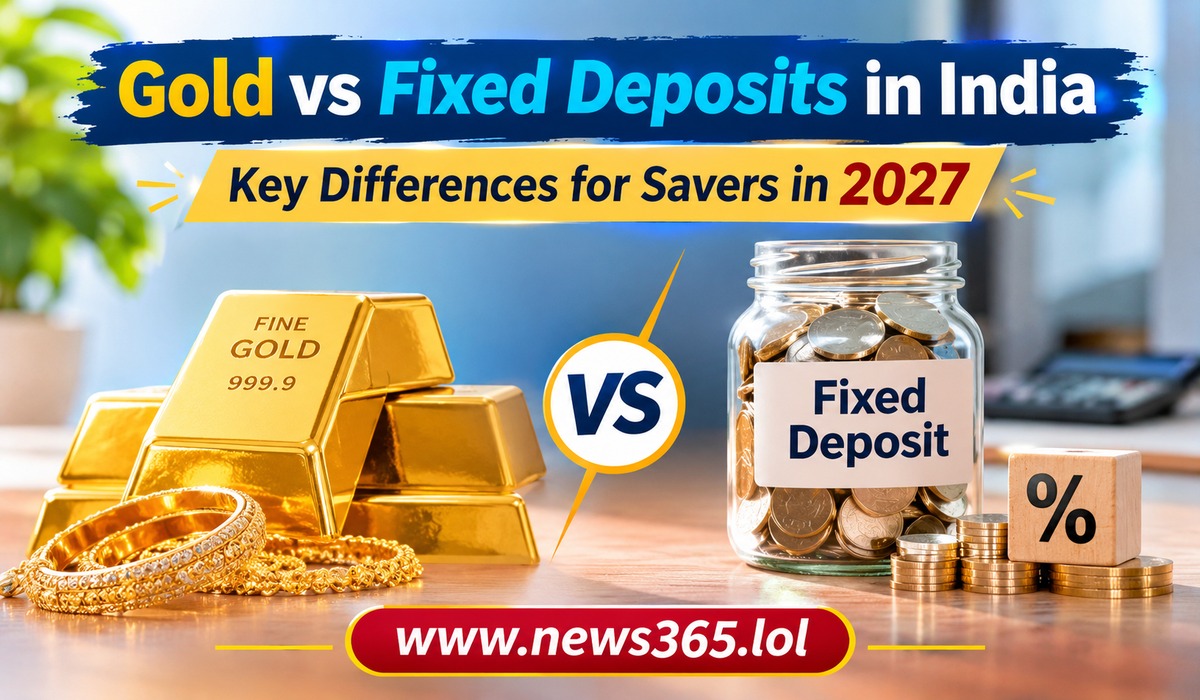
Saving money is an important part of financial planning. People in India often look for investment options that can protect their savings, provide good returns, and help them achieve future financial goals. Gold and fixed deposits (FDs) are two popular choices that have been trusted by Indian households for many years. However, both work differently and serve different financial needs.
Gold is often purchased to protect wealth and benefit from possible price increases over time. Fixed deposits, on the other hand, are preferred by people who want predictable returns and a relatively stable place to keep their money. While gold prices change according to market conditions, fixed deposits offer an interest rate agreed upon when the deposit is opened.
In 2027, choosing between gold and fixed deposits will remain an important decision for savers. Changes in gold prices, bank interest rates, inflation, and tax rules can affect the actual value of both investments. Understanding their differences can help individuals make better financial decisions.
This article explains how gold and fixed deposits compare in India, including their returns, risks, safety, taxation, and suitability for different financial goals.
Understanding Gold as an Investment in India
Gold has a special place in Indian households. It is purchased during festivals, weddings, family celebrations, and other important occasions. Apart from its traditional value, many people consider gold a way to protect their savings over a longer period.
Gold can be purchased in different forms, including jewellery, coins, bars, gold exchange-traded funds, and other gold-based investment products. Each option has different costs, storage requirements, and tax rules.
The main attraction of gold is that its market price can increase over time. When demand rises or investors look for assets outside traditional financial products, gold prices may receive support. International economic conditions, currency movements, interest rates, and global demand can also influence its price.
However, gold does not provide a fixed return. Its value can increase or decrease depending on market conditions. Someone purchasing gold at a high price may have to wait several years before receiving a favourable selling price.
Physical gold also comes with additional expenses. Jewellery buyers usually pay making charges and applicable taxes. These expenses can reduce the actual profit when the jewellery is sold. Storage and security are other important concerns for people holding large amounts of physical gold.
Understanding Fixed Deposits in India
A fixed deposit is a savings product offered by banks and certain financial institutions. Under this arrangement, a person deposits a specific amount for a selected period and receives interest according to the agreed rate.
For example, someone can deposit ₹1 lakh in a bank fixed deposit for one year, two years, or five years. The bank pays interest based on the selected deposit period and applicable interest rate.
Fixed deposits are popular because their returns are generally predictable. Unlike gold, their value does not change every day according to market prices. Investors usually know the interest rate before opening the account and can estimate how much money they will receive at maturity.
Banks offer different interest rates depending on the deposit period. Senior citizens may also receive additional interest compared with regular customers, depending on the bank’s terms.
Fixed deposits are suitable for people who want to protect their savings and earn interest without taking direct exposure to changing market prices. However, investors should remember that inflation and income tax can reduce the actual benefit of FD returns.
Gold vs Fixed Deposits: Understanding the Main Differences
Gold and fixed deposits have different purposes. Gold focuses more on possible long-term price growth, while fixed deposits focus on earning interest over a selected period.
1. Returns and Earning Potential
Returns are one of the biggest differences between gold and fixed deposits.
Gold does not offer guaranteed returns. Its price depends on market demand, international prices, currency movements, and economic conditions. During certain periods, gold prices may increase significantly. During other periods, prices may remain stable or fall.
This means investors have the opportunity to earn higher returns from gold, but there is no guarantee that this will happen.
Fixed deposits provide a more predictable return. The interest rate is decided when the deposit is opened, and the investor receives interest according to the selected payment and maturity conditions.
For example, if someone invests ₹1 lakh in an FD offering 7% annual interest, the investment can grow to approximately ₹1,07,000 after one year before tax, assuming annual compounding.
The actual return depends on the bank’s interest calculation method and deposit conditions.
For people who prefer knowing their expected earnings in advance, fixed deposits are generally easier to understand.
2. Risk and Safety
Gold and fixed deposits involve different types of risk.
Gold prices can change frequently. If an investor needs money when gold prices are low, selling the investment may result in a loss. There is also the risk of theft, damage, and additional storage expenses when holding physical gold.
Fixed deposits are generally considered more stable because their agreed interest rate does not change during the deposit period. However, they are not completely free from risk.
The safety of a bank deposit depends partly on the financial institution holding the money. In India, eligible bank deposits are insured by the Deposit Insurance and Credit Guarantee Corporation (DICGC) up to ₹5 lakh per depositor per bank, including principal and interest, subject to applicable rules.
This protection covers eligible deposits across savings, current, recurring, and fixed deposit accounts held in the same capacity.
Therefore, investors with larger savings should understand deposit insurance limits and avoid assuming that every rupee in a bank account is automatically insured.
3. Liquidity and Access to Money
Liquidity means how easily an investment can be converted into cash when required.
Gold is generally easy to sell because jewellery shops, banks, and authorised dealers may purchase eligible gold products. However, the amount received depends on purity, market price, and applicable deductions.
Jewellery may not provide the same value as its original purchase price because making charges are usually not recovered.
Fixed deposits also provide access to money, but withdrawing funds before maturity can involve penalties or reduced interest.
Some banks offer premature withdrawal facilities, while certain special deposits may have restrictions. Investors should read the terms before choosing a deposit period.
For emergency savings, keeping some money in a savings account or an easily accessible deposit may be more practical than depending entirely on gold.
4. Taxation on Gold and Fixed Deposits
Taxation is another important difference that Indian investors should understand.
Interest earned from fixed deposits is generally taxable according to the investor’s applicable income tax slab. Banks may deduct tax at source when the relevant interest payment crosses the applicable threshold, but TDS is not the final tax liability.
Gold taxation depends on the form of investment and the period for which it is held.
Under the tax rules applicable as of November 2026, physical gold held for more than 24 months generally qualifies for long-term capital gains taxation at 12.5% without indexation. Gains from shorter holding periods are generally taxed according to the applicable income tax slab.
Gold ETFs and other gold investment products can have different holding-period and taxation rules.
These rules may change before or during 2027. Investors should check the latest income tax provisions before making investment or selling decisions.
Tax should always be considered while comparing returns because the amount received after tax is more important than the headline return.
5. Protection Against Inflation
Inflation reduces the purchasing power of money over time. When the prices of everyday products increase, the same amount of money buys fewer goods and services.
Gold is often considered a way to protect wealth against inflation over longer periods. However, its price does not always increase at the same rate as inflation. It can also experience periods of falling prices.
Fixed deposits offer interest, but their real return depends on the relationship between the interest earned and inflation.
For example, if an FD provides 6.5% annual interest and inflation is 5%, the difference is relatively small before considering tax. The actual increase in purchasing power may be even lower after tax.
This is why investors should compare the after-tax FD return with inflation instead of looking only at the interest rate.
Gold vs Fixed Deposits: Which Is Better for Long-Term Savings?
The better option depends on the investor’s financial goals and investment period.
Gold may suit people who want to hold an asset for several years and are comfortable with price movements. It can also provide diversification because its market behaviour is different from traditional bank deposits.
However, gold should not be treated as a guaranteed source of income. It does not pay regular interest, and investors cannot predict its future selling price.
Fixed deposits are generally more suitable for people who want predictable earnings. They can be useful for planned expenses, short-term savings, and people who prefer avoiding market-related price changes.
For example, someone saving money for a house payment within the next two years may prefer an FD with a suitable maturity period rather than depending on gold prices.
A person saving for a long-term financial goal may consider holding some gold along with other investments, depending on their financial situation.
What Should Investors Consider Before Investing in 2027?
Before choosing gold or fixed deposits in 2027, investors should understand their financial needs.
The first consideration should be the investment period. Money needed within a short time should generally be kept in options with more predictable values and easy access. Long-term savings may allow greater flexibility to include assets whose prices change.
The second consideration should be the investor’s ability to accept risk. Someone who becomes uncomfortable when investment prices fall may prefer fixed deposits over holding a large amount of gold.
Interest rates should also be compared carefully. Different banks offer different FD rates, and the highest rate does not always mean the best choice. The bank’s reliability, deposit conditions, and withdrawal rules also matter.
Gold buyers should consider the form in which they want to invest. Jewellery is useful for personal and family purposes, but it may not be the most cost-effective investment because of making charges and selling deductions. Gold ETFs may offer a more convenient way to invest in gold prices, although they also involve market risk and related expenses.
Finally, investors should avoid putting all their savings into one asset. Keeping emergency money separate and spreading investments across suitable options can make financial planning more balanced.
Can Investors Choose Both Gold and Fixed Deposits?
Yes, investors can hold both gold and fixed deposits instead of choosing only one.
These investments serve different purposes. Fixed deposits can provide predictable interest income, while gold can offer exposure to changes in gold prices.
For example, a person with ₹5 lakh in savings may decide to keep a portion in fixed deposits and another portion in gold, while maintaining enough accessible money for emergencies.
The exact allocation should depend on income, financial responsibilities, age, investment period, and future expenses.
There is no single allocation that works for everyone. A person saving for retirement may have different needs from someone building an emergency fund or preparing for a major purchase.
The main idea is to avoid depending on only one investment option. A balanced approach can help reduce the impact of unexpected changes in market conditions.
Conclusion
Gold and fixed deposits are two important savings options in India, but they serve different financial purposes. Gold offers the possibility of long-term price growth and can help diversify savings, but its value changes with market conditions. Fixed deposits provide predictable interest earnings and are generally more suitable for people who want stability.
In 2027, investors should consider interest rates, gold prices, inflation, taxes, and their personal financial goals before making a decision.
Rather than treating gold and fixed deposits as competing choices, savers can consider using both in a balanced way. Fixed deposits can support financial stability, while gold can provide exposure to another type of asset.
The best investment is not necessarily the one offering the highest possible return. It is the one that matches your financial needs, investment period, and comfort with risk.
Frequently Asked Questions (FAQs)
1. Is gold a better investment than fixed deposits in India in 2027?
Neither option is better for everyone. Gold may offer higher returns when prices increase, but it also involves price risk. Fixed deposits provide predictable interest and are generally more suitable for people who prefer stability.
2. Are fixed deposits safe for long-term savings?
Fixed deposits with insured banks are generally considered a relatively safe savings option. Eligible deposits receive DICGC insurance up to ₹5 lakh per depositor per bank, including principal and interest. Investors should also consider the bank’s financial position and deposit conditions.
3. Can gold provide regular income like a fixed deposit?
Physical gold and gold ETFs do not generally provide regular interest income. Their potential returns mainly come from changes in gold prices. Fixed deposits provide interest according to the selected deposit terms.
4. Is interest earned from fixed deposits taxable in India?
Yes. FD interest is generally added to the investor’s taxable income and taxed according to the applicable income tax slab. Banks may deduct TDS when the relevant conditions and thresholds are met.
5. Should beginners invest in gold or fixed deposits first?
Beginners should first understand their financial goals and emergency savings requirements. Fixed deposits may be easier to understand because their interest rates are known in advance. Gold can be considered as an additional investment for diversification, depending on the investor’s financial situation.