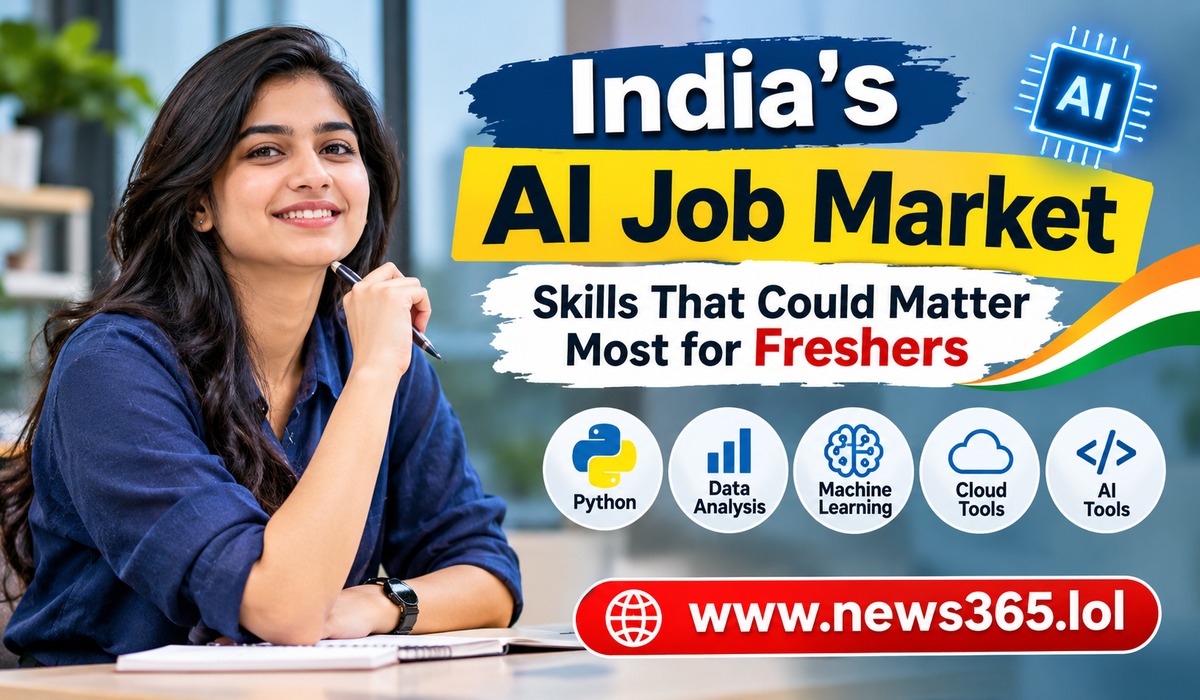
Artificial Intelligence (AI) is changing the way companies work, hire employees, and manage everyday business activities. From customer support and software development to banking, healthcare, education, and marketing, AI is becoming an important part of many industries. As companies continue adopting these technologies, the demand for people who understand how to use AI is also increasing.
For fresh graduates in India, this change brings new career opportunities as well as new challenges. Earlier, having a college degree and basic computer knowledge was often enough to apply for an entry-level job. Today, employers are looking for candidates who can work with modern technology, solve practical problems, understand data, and use AI tools effectively.
However, this does not mean every fresher needs to become an AI engineer or learn advanced programming. Companies also need people who can use AI tools in business operations, analyse information, check AI-generated results, and improve everyday work processes.
India’s AI job market is therefore creating opportunities for graduates from different educational backgrounds. Understanding which skills could matter most can help freshers prepare for their first job and build a stronger career.
How AI Is Changing India’s Job Market
India has become an important destination for technology companies, software development centres, and businesses that provide digital services. Many organisations are now investing in AI to improve productivity, reduce repetitive work, and offer better services to customers.
Companies are moving beyond simply testing AI tools. They are increasingly looking for employees who can help introduce these technologies into their regular business activities.
According to foundit’s January 2026 hiring report, India’s AI job postings reached approximately 2.9 lakh in 2025. The report projected that demand could increase by 32% in 2026, reaching nearly 3.82 lakh roles. Generative AI, AI engineering, and systems for putting AI models into everyday use were among the important areas of growth.
This change is also affecting entry-level recruitment. Employers are looking for graduates who understand both technology and its practical uses. Some companies want freshers with programming knowledge, while others need candidates who can work with AI-powered business tools.
The important point is that AI is not creating opportunities only for highly experienced professionals. Freshers who develop useful skills and gain practical experience can also find ways to enter this growing market.
1. Basic Understanding of Artificial Intelligence
Understanding AI is becoming an important starting point for fresh graduates. Before learning advanced tools or programming languages, candidates should understand what AI does, how it works at a basic level, and where businesses use it.
Freshers should become familiar with technologies such as machine learning, generative AI, chatbots, and AI-based automation. They should also understand the difference between traditional software and AI-powered applications.
For example, a traditional computer program generally follows instructions written by developers. An AI system can identify patterns in information and generate responses based on what it has learned.
This basic understanding can help freshers communicate better with technical teams and understand how AI can solve business problems.
Students from commerce, management, arts, science, and engineering backgrounds can all benefit from learning AI fundamentals. They do not need to become experts immediately. A clear understanding of common AI applications is a useful first step.
2. Python Programming Skills
Python is one of the most widely used programming languages in AI development. Its simple structure makes it a popular choice for beginners who want to enter software development, data analysis, or machine learning.
Freshers interested in technical AI careers should consider learning Python because it is used to handle information, build applications, automate tasks, and work with AI models.
Learning the basics of Python can also improve problem-solving abilities. Students can start with simple programs and gradually move towards working with data and building small applications.
For example, a fresher could create a simple program that organises information from a spreadsheet or develops a basic chatbot for answering common questions.
A strong understanding of programming fundamentals is more useful than simply collecting certificates. Employers are more interested in seeing whether candidates can use their knowledge to complete practical tasks.
3. Data Analysis and Data Understanding
AI systems depend heavily on data. Companies use information about customers, sales, products, employees, and business activities to make better decisions.
This makes data analysis an important skill for freshers entering India’s technology and business sectors.
Students should learn how to organise information, identify patterns, understand numbers, and present findings clearly. Knowledge of Microsoft Excel, SQL, and data visualisation tools can provide a useful starting point.
For example, an online shopping company may want to understand why customers are leaving products in their shopping carts. A data analyst can study customer activity and identify possible reasons.
AI tools can support this work, but employees still need to understand whether the information is correct and what it means for the business.
Data-related skills can create opportunities in banking, marketing, retail, healthcare, finance, and technology companies. They are also useful for graduates who do not want to become full-time programmers.
4. Generative AI and AI Tool Usage
Generative AI tools are changing how people create content, prepare reports, write code, research information, and communicate with customers.
Freshers should understand how to use these tools responsibly and effectively. Learning to give clear instructions, improve responses, check information, and use AI for specific tasks can make everyday work easier.
However, simply knowing how to enter questions into an AI chatbot is not enough. Candidates should understand how to get useful results and recognise when an answer may be incorrect.
For example, a marketing fresher can use AI to develop content ideas, organise campaign information, and prepare initial drafts. A software development fresher can use AI coding assistants to understand errors and explore possible solutions.
The final work still needs human checking and improvement.
Companies increasingly value employees who can combine their own knowledge with AI tools instead of depending completely on automatically generated answers.
5. Machine Learning Fundamentals
Machine learning is an important part of artificial intelligence. It allows computer systems to learn patterns from existing information and use those patterns to make predictions or decisions.
Freshers interested in technical AI careers should understand basic machine learning concepts.
For example, a bank may use machine learning to identify unusual financial transactions. An online shopping platform may use it to suggest products based on customer interests.
Students can begin by understanding how computers learn from examples, how training information is used, and why the quality of data matters.
After learning the basics, interested candidates can explore beginner-level projects using Python and commonly used machine learning tools.
Machine learning may require more technical preparation than general AI tool usage. However, it can create opportunities for graduates who want to work in AI development, software engineering, and related technical roles.
6. Cybersecurity and Data Protection
As businesses use more AI-powered applications, protecting information is becoming increasingly important.
Companies handle customer details, financial records, employee information, and confidential business documents. Poor security practices can expose this information to online attacks and misuse.
Freshers should understand basic cybersecurity principles, including password safety, secure access, phishing attacks, data protection, and safe use of digital applications.
Students interested in technology careers can explore network security, cloud security, and basic security testing.
Cybersecurity knowledge is also useful for people working in customer support, finance, administration, and business operations because these roles may involve handling sensitive information.
AI can help security teams identify unusual activity, but human employees are still needed to understand risks and respond appropriately.
7. Cloud Computing Knowledge
Many AI applications require powerful computer systems and large amounts of storage. Instead of maintaining all these resources themselves, businesses often use cloud services.
Cloud computing allows companies to store information, run applications, and access computing resources through internet-based platforms.
Freshers should become familiar with the basic ideas behind cloud computing. Learning about services offered by Amazon Web Services, Microsoft Azure, and Google Cloud can be helpful for students interested in technical careers.
Understanding how applications are stored, accessed, and maintained online can improve a candidate’s knowledge of modern business technology.
Cloud computing is particularly useful for graduates interested in software development, AI engineering, data engineering, and cybersecurity.
8. Communication and Problem-Solving Skills
Technical knowledge alone cannot guarantee a successful career. Freshers also need to explain their ideas, understand instructions, and work comfortably with other people.
Communication skills are important because AI projects often involve different teams. Developers, designers, managers, analysts, and business employees may need to work together.
Problem-solving is equally valuable. Companies do not simply want employees who can operate software. They need people who can understand a problem and identify a practical way to solve it.
For example, if an AI chatbot gives incorrect information to customers, an employee should be able to identify the issue, explain it to the technical team, and help improve the response.
Good communication, patience, teamwork, and willingness to learn can help freshers become more effective employees.
9. AI Testing and Quality Checking
AI applications do not always provide correct answers. They can misunderstand questions, produce incomplete information, or generate results that are not suitable for business use.
This creates a need for people who can test AI applications and check whether their results are useful and reliable.
Freshers can explore basic software testing, checking AI-generated responses, identifying errors, and reporting problems clearly.
For example, a company developing an AI customer support system may need employees to test different questions and check whether the system provides accurate answers.
This type of work can be a starting point for graduates interested in software testing, AI quality assurance, and technology operations.
It also shows that AI careers are not limited to building new models. Testing and improving existing applications are important parts of the industry.
10. Industry Knowledge and Practical Experience
AI skills become more valuable when candidates understand how a particular industry works.
A graduate interested in banking should understand basic financial services. Someone interested in healthcare technology should learn about common healthcare processes. A marketing graduate should understand customers, advertising, and online business activities.
Combining industry knowledge with AI skills can help freshers identify problems that technology can solve.
Practical experience is also becoming important during recruitment. Deloitte India’s Campus Workforce Trends 2026 highlights the growing importance of AI skills, learning ability, practical experience, and problem-solving in early-career hiring.
Freshers can gain experience through internships, college projects, online assignments, and personal applications. Even a small project can demonstrate that a candidate knows how to apply classroom learning.
Which AI Jobs Can Freshers Explore in India?
India’s growing AI industry offers different types of opportunities for graduates. The right role depends on their education, technical knowledge, and interests.
Students with programming and mathematics knowledge can explore junior AI developer, machine learning assistant, and software development positions.
Graduates who enjoy working with numbers may consider junior data analyst and business intelligence roles. Those interested in checking software quality can explore AI testing and quality assurance positions.
Freshers with strong communication and research abilities may find opportunities in AI operations, content evaluation, and customer experience teams.
There are also opportunities in digital marketing, business analysis, and administrative operations where AI tools are becoming part of everyday work.
The important thing is to select a career direction instead of trying to learn every available AI technology at the same time.
How Freshers Can Prepare for AI Jobs
Preparing for an AI-related job does not require learning everything in a few weeks. Freshers should begin with basic concepts and gradually develop skills that match their career interests.
Students interested in technical positions can start with Python, basic mathematics, data handling, and machine learning. Those interested in business roles can focus on AI tools, Excel, data analysis, and communication.
Building practical projects is another useful way to improve job readiness. A simple chatbot, sales report, automated spreadsheet, or customer feedback analysis project can demonstrate practical knowledge.
Freshers should also create a professional resume that explains their actual skills and project experience. Instead of mentioning many tools without examples, they should describe what they have created and how it works.
Internships can provide valuable workplace experience. They allow students to understand company expectations, work with experienced employees, and become familiar with real business activities.
Final Thoughts
India’s AI job market is creating new opportunities for fresh graduates, but employers are also becoming more careful about the skills they expect from candidates.
A college degree remains important, but practical knowledge, problem-solving, communication, and the ability to work with modern technology can make a candidate more competitive.
Freshers do not need to master every AI tool or become expert programmers to begin their careers. They should identify their interests, choose useful skills, and spend time applying what they learn.
The future of work will not depend only on people who build AI systems. It will also depend on employees who know how to use these systems, check their results, protect information, and apply technology to everyday problems.
For freshers entering India’s job market, the best approach is to stay curious, keep learning, and develop skills that connect technology with real business needs.
Frequently Asked Questions
1. Is AI a good career option for freshers in India?
Yes, AI can be a promising career option for freshers. Opportunities are developing in AI development, data analysis, software testing, AI operations, and business applications. However, candidates need relevant skills and practical experience to improve their chances of getting hired.
2. Which AI skill should freshers learn first?
Freshers can begin with basic AI concepts and learn how common AI tools work. Students interested in technical careers can then explore Python and data analysis, while those interested in business roles can focus on AI applications and problem-solving.
3. Do freshers need coding skills to get an AI job?
Not every AI-related position requires coding. Technical roles usually need programming knowledge, but jobs involving AI testing, business operations, content evaluation, and digital marketing may require more focus on AI tools and communication skills.
4. Can commerce and arts students build a career in AI?
Yes, commerce and arts graduates can explore AI-related opportunities. They can learn AI tools, data analysis, digital marketing, business applications, and customer support technologies. Understanding how AI helps businesses can create opportunities beyond traditional technical roles.
5. How can freshers get practical AI experience?
Freshers can build small AI projects, complete online training, participate in internships, and practise using AI applications. Creating a portfolio that demonstrates real work can help employers understand a candidate’s abilities.