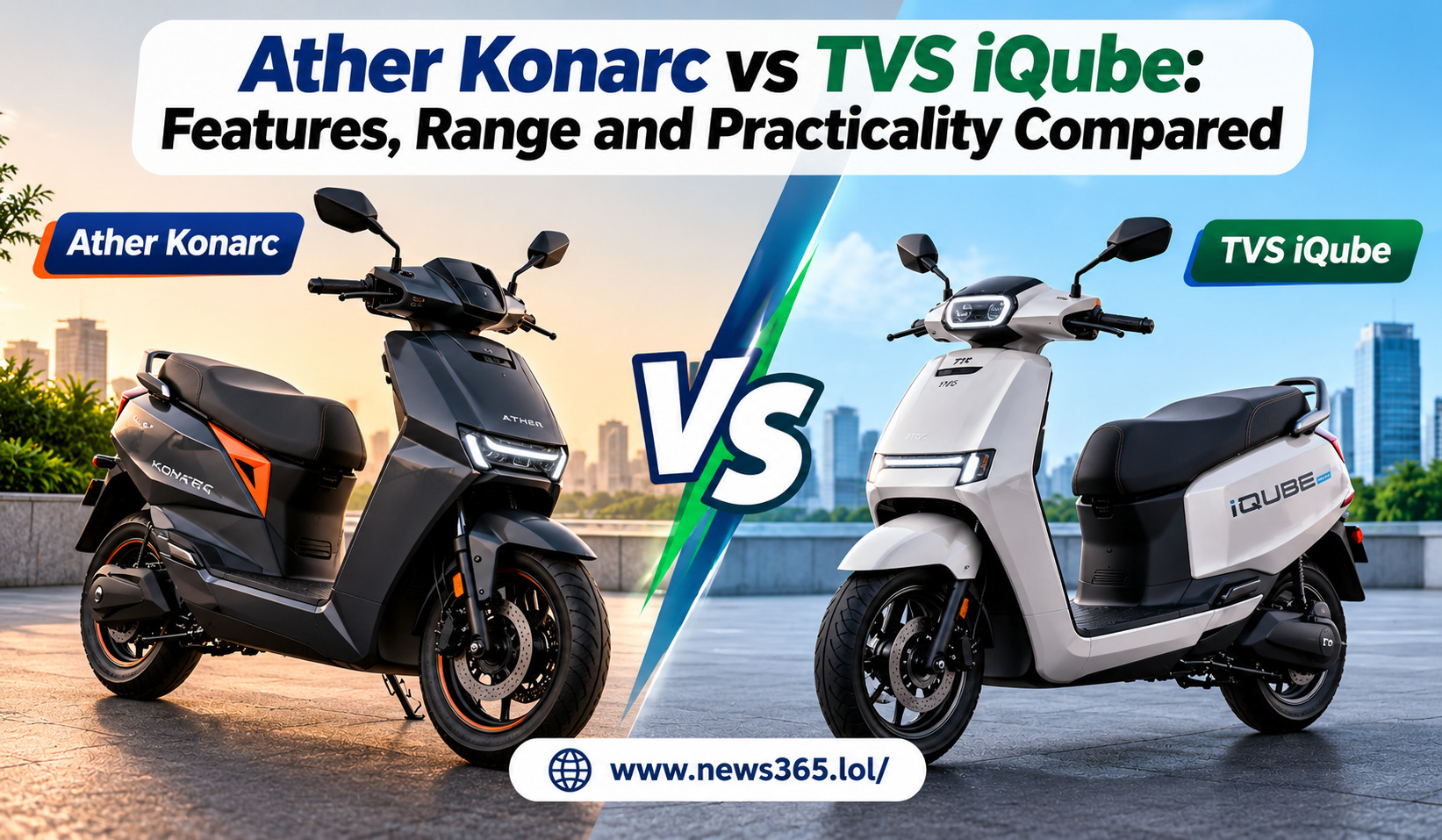
India’s electric scooter market is expanding with new models offering better battery technology, improved riding comfort and smart connectivity. Among the interesting options in this segment are the Ather Konarc and TVS iQube. Both electric scooters are designed for everyday commuting, but they follow different approaches to performance, practicality, technology and customer convenience.
The Ather Konarc is a new electric scooter built on the company’s EL platform. It focuses on everyday usability, a strong metal body, long-travel suspension and connected features. Meanwhile, the TVS iQube has established itself as a family-oriented electric scooter with multiple battery configurations, practical storage and a wide dealership network.
For buyers planning to switch from petrol scooters to electric mobility, comparing these two models can help identify the right option. Here is a detailed look at the Ather Konarc vs TVS iQube, including price, battery, claimed range, features, comfort and everyday practicality.
Ather Konarc vs TVS iQube: Price and Variants
Price is an important consideration when purchasing an electric scooter. Both manufacturers offer different configurations to accommodate customers with varying budgets and commuting requirements.
The Ather Konarc S is available in three announced configurations. The 100 km IDC variant is priced at ₹99,999, while the 125 km version costs ₹1,21,999. The 161 km variant is priced at ₹1,44,999. These are introductory ex-showroom prices.
Ather has also announced a 200 km IDC version and a more feature-rich Konarc Z range, with availability and pricing dependent on the company’s rollout plans.
The TVS iQube offers a wider selection of variants. Its lineup includes 2.3 kWh, 3.1 kWh and 3.5 kWh configurations, along with the iQube S 4.7 kWh and iQube ST 5.3 kWh models. The manufacturer’s listed effective ex-showroom prices start at approximately ₹95,124 and extend to ₹1,48,877, depending on the variant and applicable benefits.
The iQube therefore offers more choices for customers looking at different battery capacities and price points. However, buyers should check the latest dealership quotations because subsidies, state incentives and introductory offers can affect the final purchase price.
Battery Capacity and Claimed Riding Range
Battery capacity directly influences how far an electric scooter can travel on a single charge. It is particularly important for people who regularly commute to offices, colleges or other destinations.
The Ather Konarc S comes with three currently announced battery configurations. The entry-level 100 km model uses a 2.1 kWh battery, the 125 km version gets a 2.7 kWh battery, and the 161 km variant features a 3.5 kWh battery. Ather has also announced a future 200 km IDC configuration.
The TVS iQube provides several battery choices, ranging from 2.3 kWh to 5.3 kWh. Depending on the variant, its claimed IDC range is between 114 km and 212 km.
The 2.3 kWh version offers 114 km, while the 3.1 kWh model provides 123 km. The 3.5 kWh configuration delivers 145 km, and the iQube S 4.7 kWh offers 175 km. The top-end iQube ST 5.3 kWh has a claimed IDC range of 212 km.
On paper, the top-end TVS iQube currently offers a higher claimed range than the available Konarc S variants. However, Ather’s planned 200 km version could make the comparison more competitive.
Actual riding range can differ from IDC figures because of traffic, road conditions, riding modes, passenger weight, speed and weather. Buyers should consider their daily travel distance rather than relying entirely on advertised range figures.
Motor Performance and Top Speed
Motor performance is another important factor when comparing electric scooters. It affects acceleration, overtaking ability and the overall riding experience.
The Ather Konarc S uses a permanent magnet synchronous motor. Its entry-level version produces 4 kW of peak power, while the higher 125 km and 161 km variants offer 4.7 kW of peak power. All three have a claimed top speed of 70 kmph.
The TVS iQube uses a hub-mounted BLDC electric motor with up to 4.4 kW of peak power. Its entry-level 2.3 kWh variant has a claimed top speed of 68 kmph, while the higher battery configurations can reach 82 kmph.
This gives the higher-specification TVS iQube an advantage in claimed top speed. The Ather Konarc, however, offers competitive motor output in its higher battery configurations.
For everyday city commuting, both scooters provide performance suitable for regular urban travel. The final riding experience will also depend on acceleration response, riding modes and road conditions.
Features and Technology Compared
Modern electric scooters offer more than basic transportation. Digital displays, smartphone connectivity, navigation and safety technology have become important features for buyers.
The Ather Konarc focuses on a technology-driven riding experience. Its features include Google Maps integration, theft and tow alerts, AutoHold, Park Assist and connected smartphone functions. It also supports AtherStack Pro features, depending on the selected configuration.
The scooter introduces a new steel unibody chassis and metal body construction. Its Silent Gear Drive is another notable feature, designed to provide quieter operation.
The TVS iQube offers SmartXonnect technology with more than 118 connected features. Depending on the variant, customers get a TFT display, turn-by-turn navigation, call alerts, live vehicle tracking, ride statistics, remote battery monitoring and over-the-air software updates.
Additional convenience features include Q-Park Assist, hill-hold functionality and reverse assistance on supported variants.
Both scooters offer useful technology, but their feature availability differs according to the selected model. The iQube has an established connected ecosystem, while the Konarc introduces Ather’s newer EL platform and technology package.
Comfort, Storage and Everyday Practicality
Comfort and storage are essential for people using electric scooters every day. A vehicle may offer an impressive range, but its seating position, suspension and luggage capacity also influence its usefulness.
The Ather Konarc has been developed with Indian road conditions in mind. It features a 14-inch front wheel, a 12-inch rear wheel and long-travel suspension. The front suspension travel is 90 mm, while the rear offers 100 mm. These specifications are intended to improve comfort when travelling over uneven surfaces.
It also provides 31 litres of under-seat storage, making it useful for carrying everyday belongings. Its steel unibody chassis and metal body construction are additional highlights.
The TVS iQube follows a family-oriented design with an upright seating position, a wide seat and a spacious footboard. It offers up to 32 litres of under-seat storage, depending on the configuration. The scooter also features a portable charger that can be connected to a standard 15A household socket.
For customers who regularly travel with a pillion passenger or carry shopping bags, the iQube’s practical layout is worth considering. The Konarc’s larger front wheel and suspension setup may appeal to people who frequently encounter uneven city roads.
Charging and Ownership Experience
Charging convenience plays an important role in electric scooter ownership. Both manufacturers provide solutions for home charging, although their charging ecosystems differ.
Ather supports home charging as well as access to its Ather Grid public charging network. The company advertises super-fast home charging capabilities for the Konarc, with charging arrangements depending on the selected variant and equipment.
TVS provides a portable charging solution for the iQube. Owners can charge the scooter using a compatible household power socket. Charging duration varies according to battery capacity and charger specifications.
Ownership experience also depends on service availability. TVS benefits from its established dealership and service network across India. Ather has been expanding its retail, service and public charging infrastructure to support its electric scooter customers.
Before purchasing either scooter, buyers should check the availability of authorised service centres, battery warranty conditions, charging facilities and replacement-part support in their city.
Which Electric Scooter Should You Choose?
The Ather Konarc and TVS iQube target customers looking for practical electric mobility, but their strengths are different.
The Ather Konarc is worth considering if you prefer a modern electric scooter with a metal body, larger front wheel, long-travel suspension and Ather’s connected technology. Its multiple battery configurations also provide flexibility for different commuting requirements.
The TVS iQube is a strong option for buyers who prioritise family-friendly practicality, multiple battery choices, established service support and a longer claimed range in the top-end ST variant.
For longer daily commutes, the iQube ST 5.3 kWh currently has an advantage with its 212 km IDC range. For people interested in newer engineering and Ather’s latest platform, the Konarc deserves consideration.
Conclusion
The Ather Konarc vs TVS iQube comparison highlights two different approaches to India’s growing electric scooter market. The Konarc focuses on modern engineering, metal construction, suspension and connected technology, while the iQube emphasises family comfort, storage, battery choices and established ownership support.
The TVS iQube currently offers a wider variant lineup and a higher claimed range in its top-end configuration. Meanwhile, the Ather Konarc brings interesting new features and an alternative design approach for everyday commuting.
Ultimately, the better electric scooter depends on your budget, daily travel distance, preferred features and local service availability. Taking test rides and comparing the latest on-road prices can help you make a more informed buying decision.