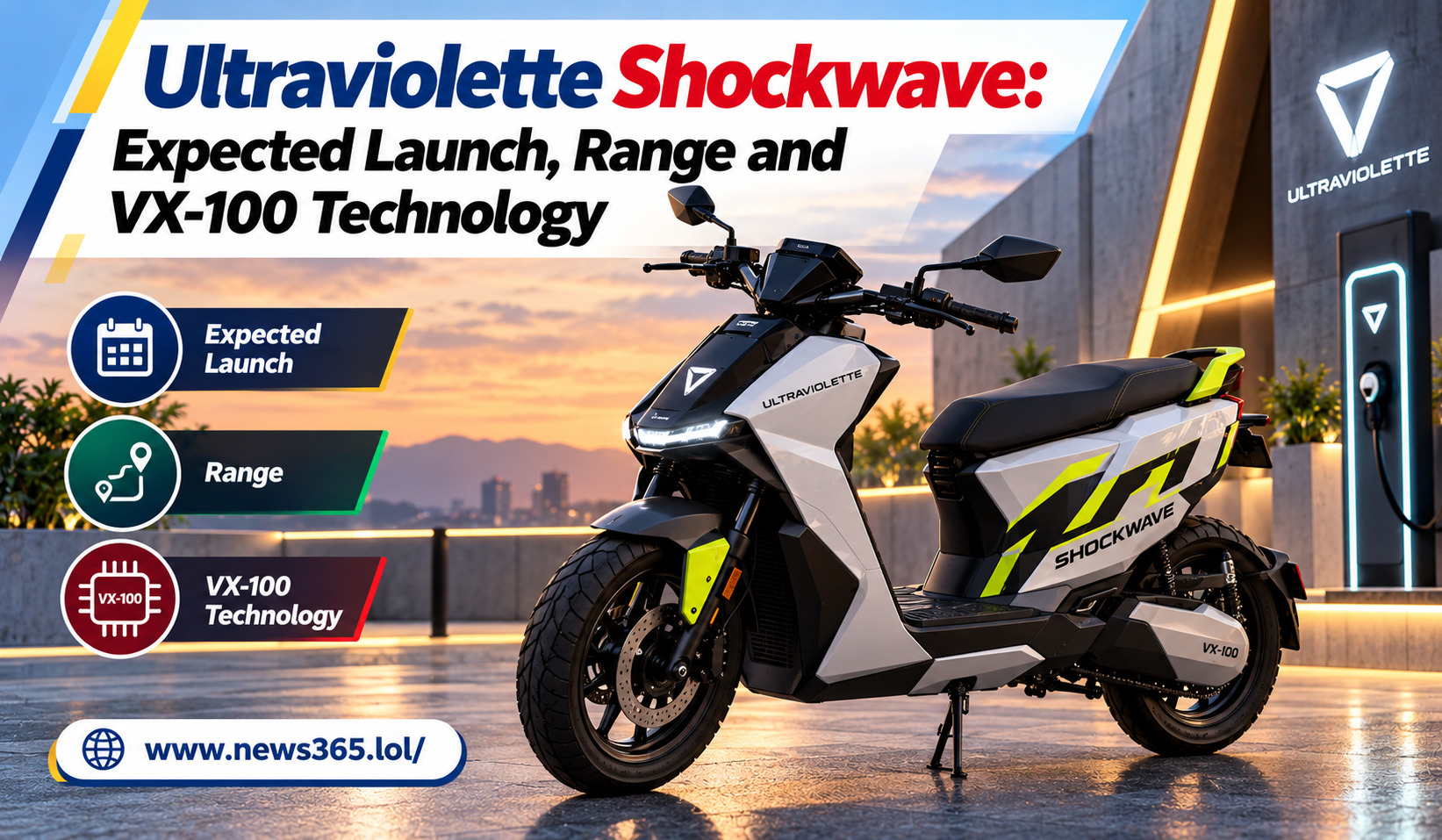
India’s electric motorcycle market is entering an interesting phase, with manufacturers developing products that combine performance, advanced battery technology and practical everyday usability. One upcoming motorcycle attracting attention is the Ultraviolette Shockwave. Developed by Bengaluru-based Ultraviolette Automotive, this electric motorcycle is designed for riders who want a lightweight machine with an adventurous character and strong performance.
The Ultraviolette Shockwave was originally unveiled in March 2025, with an introductory price announcement of ₹1.50 lakh. However, its launch timeline has changed as the company has worked on upgrading the motorcycle to its new 100V electrical architecture, known as VX-100.
The latest announcement points towards an India launch in the first quarter of 2027. With its claimed 165 km range, 120 kmph top speed and off-road-inspired design, the Shockwave could become an interesting option in India’s electric motorcycle segment.
Let’s explore the expected launch date, price, battery range, performance, features and VX-100 technology.
Ultraviolette Shockwave Expected Launch in India
Ultraviolette first introduced the Shockwave at its Fast Forward event in Bengaluru in March 2025. At the time, the company announced an introductory price of ₹1.50 lakh for the first 1,000 bookings, followed by a regular announced price of ₹1.75 lakh (ex-showroom).
The motorcycle was initially expected to reach customers in the first quarter of 2026. However, the company subsequently revised its development plans and confirmed that the production version would use the new 100V VX-100 architecture.
According to the latest announcement from September 2026, the Ultraviolette Shockwave is now expected to launch in India in Q1 2027. Manufacturing preparations are already underway at the company’s existing facility in Hosur, Tamil Nadu.
The motorcycle is expected to be offered in single-seat and dual-seat configurations. More details about the final production specifications, booking process and delivery schedule are expected closer to its launch.
Ultraviolette Shockwave Expected Price
Price will be an important factor in determining the Shockwave’s position in India’s electric motorcycle market.
When the motorcycle was first unveiled, Ultraviolette announced an introductory price of ₹1.50 lakh for the first 1,000 customers. The subsequent announced price was ₹1.75 lakh (ex-showroom).
However, the introduction of the VX-100 architecture and changes to the motorcycle’s development mean buyers should not assume that the original pricing will remain unchanged for the production version.
The final launch price has not yet been reconfirmed. The company is expected to share updated pricing information closer to the Q1 2027 launch.
If Ultraviolette manages to retain a competitive price, the Shockwave could attract riders interested in an electric alternative to lightweight adventure-oriented petrol motorcycles.
Battery Capacity and Expected Riding Range
Battery capacity and riding range are among the most important considerations when purchasing an electric motorcycle.
At its original unveiling, the Ultraviolette Shockwave was announced with a claimed IDC range of 165 km on a single charge. However, the company did not initially disclose the battery capacity in its launch announcement.
The latest VX-100 update introduces changes to the motorcycle’s electrical architecture, battery system and powertrain. Therefore, the final battery specifications and certified range of the production version still need confirmation.
The previously announced 165 km IDC range provides an indication of the motorcycle’s intended capability, but buyers should wait for the final production specifications before making comparisons with other electric motorcycles.
Actual riding range will depend on riding speed, road conditions, terrain, acceleration, passenger weight and weather. Frequent high-speed riding and off-road use can also affect battery consumption.
For city commuters, a confirmed practical range will be particularly important, while recreational riders will want to understand how the battery performs during longer journeys.
Motor Performance and Top Speed
Performance is one of the biggest attractions of the Ultraviolette Shockwave. Unlike conventional commuter electric scooters, this motorcycle is designed around a lightweight, performance-focused riding experience.
The original announced specifications include a chassis-mounted Interior Permanent Magnet Synchronous Motor (IPMSM). It produces approximately 14.5 hp of power and 505 Nm of torque at the rear wheel.
The motorcycle has a claimed top speed of 120 kmph and can accelerate from 0 to 60 kmph in approximately 2.9 seconds.
The 505 Nm torque figure is measured at the rear wheel after the drivetrain’s gearing multiplication. It should not be directly compared with the motor torque figures of other electric motorcycles.
The motorcycle’s claimed weight is approximately 120 kg, which supports its lightweight positioning.
These figures were announced before the latest VX-100 update. The company has not yet confirmed whether all the original performance specifications will remain unchanged in the production model.
What Is VX-100 Technology?
VX-100 is one of the most important developments associated with the updated Ultraviolette Shockwave. It refers to the company’s new 100V electrical architecture, developed to improve the performance and efficiency of its electric two-wheelers.
The architecture made its production debut with the updated X-47 Venom and is also planned for the upcoming Shockwave and Tesseract electric scooter.
According to Ultraviolette, the VX-100 platform offers several advantages over its earlier electrical architecture.
One major improvement is higher battery energy density. The company claims up to 25% higher battery energy density, allowing it to improve energy storage within a given packaging space.
Thermal management is another important development. The platform is designed to deliver improved cooling performance, helping manage heat generated during demanding riding conditions.
The architecture also focuses on faster charging and reduced weight in key powertrain components. Its updated battery pack, motor, controller and vehicle electronics are designed to work together as an integrated system.
For the Shockwave, these improvements could support better power delivery, charging performance and overall energy management. However, the exact production benefits and charging figures for this motorcycle are yet to be announced.
Design, Suspension and Off-Road Features
The Ultraviolette Shockwave follows an enduro-inspired design that makes it visually different from conventional electric commuter motorcycles.
Its tall front profile, slim bodywork and wire-spoke wheels give it an adventurous appearance. The motorcycle uses a 19-inch front wheel and a 17-inch rear wheel, combined with dual-purpose tyres.
Suspension is another major highlight. The original announced setup includes a 37 mm cartridge-type front fork with 200 mm of travel and a rear monoshock offering 180 mm of wheel travel.
These specifications are intended to support riding on uneven roads and recreational trails.
The braking setup includes a 270 mm front disc with an axial-mounted dual-piston caliper and a 220 mm rear disc with a floating single-piston caliper.
The motorcycle is also expected to offer two colour options: Cosmic Black and Frost White.
Features and Technology
The Ultraviolette Shockwave is expected to offer a technology package designed around performance, safety and rider control.
Its announced features include a 5-inch full-colour TFT instrument display that provides important riding information. The motorcycle also gets dual-projector LED headlamps for improved visibility.
Some of its major riding and safety features include:
Four traction control modes: Riders can select different traction control settings according to road conditions and riding preferences. The system is designed to help manage rear-wheel grip.
Switchable dual-channel ABS: The motorcycle features dual-channel ABS that can be switched off when required. This provides flexibility for riders interested in controlled off-road riding.
Six levels of dynamic regeneration: The regenerative braking system offers six adjustment levels, allowing riders to select how much energy recovery they want during deceleration.
Single-seat and dual-seat options: Buyers will be able to choose between different seating configurations according to their requirements.
The availability and final specifications of these features will need confirmation when the production model launches.
Ultraviolette Shockwave vs Conventional Electric Motorcycles
The Shockwave is positioned differently from regular electric commuter motorcycles. Its enduro-inspired styling, high ground clearance-oriented design approach and long-travel suspension make it suitable for riders interested in a more adventurous electric motorcycle.
Its 120 kmph claimed top speed and 2.9-second acceleration from 0 to 60 kmph also indicate a stronger performance focus than that of typical city-oriented electric two-wheelers.
The motorcycle could attract customers who currently consider lightweight petrol motorcycles for city travel and occasional recreational riding.
However, its actual suitability for off-road use will depend on factors such as ground clearance, suspension tuning, tyre performance, battery protection and overall handling. These details should be evaluated through the final production model.
What to Expect from the Ultraviolette Shockwave in 2027?
The Q1 2027 launch will be an important milestone for Ultraviolette as it expands its electric two-wheeler portfolio.
The company is preparing the Shockwave alongside the Tesseract electric scooter, with both models expected to use the VX-100 architecture.
The updated electrical platform could help Ultraviolette introduce more advanced battery and motor technology across different vehicle categories.
Production preparations at its Hosur facility are another important development. The company is working to increase manufacturing capacity and expand its dealership network to support its upcoming products.
For potential Shockwave buyers, the most important upcoming announcements will include the final battery capacity, certified riding range, charging time, updated price and delivery timeline.
Conclusion
The Ultraviolette Shockwave is an interesting upcoming electric motorcycle for India’s evolving EV market. Its enduro-inspired design, lightweight positioning, claimed 165 km range and 120 kmph top speed make it different from conventional electric commuter motorcycles.
The introduction of VX-100 technology is another major development. Its improved battery energy density, thermal management, charging performance and powertrain integration could make the production version more competitive.
With its India launch now expected in the first quarter of 2027, the Shockwave could attract riders looking for a performance-oriented electric motorcycle with recreational capabilities.
However, the final buying decision should depend on the confirmed production specifications, actual riding range, updated pricing and availability of service support. More details from Ultraviolette closer to launch will determine how competitive the Shockwave becomes in India’s electric motorcycle market.