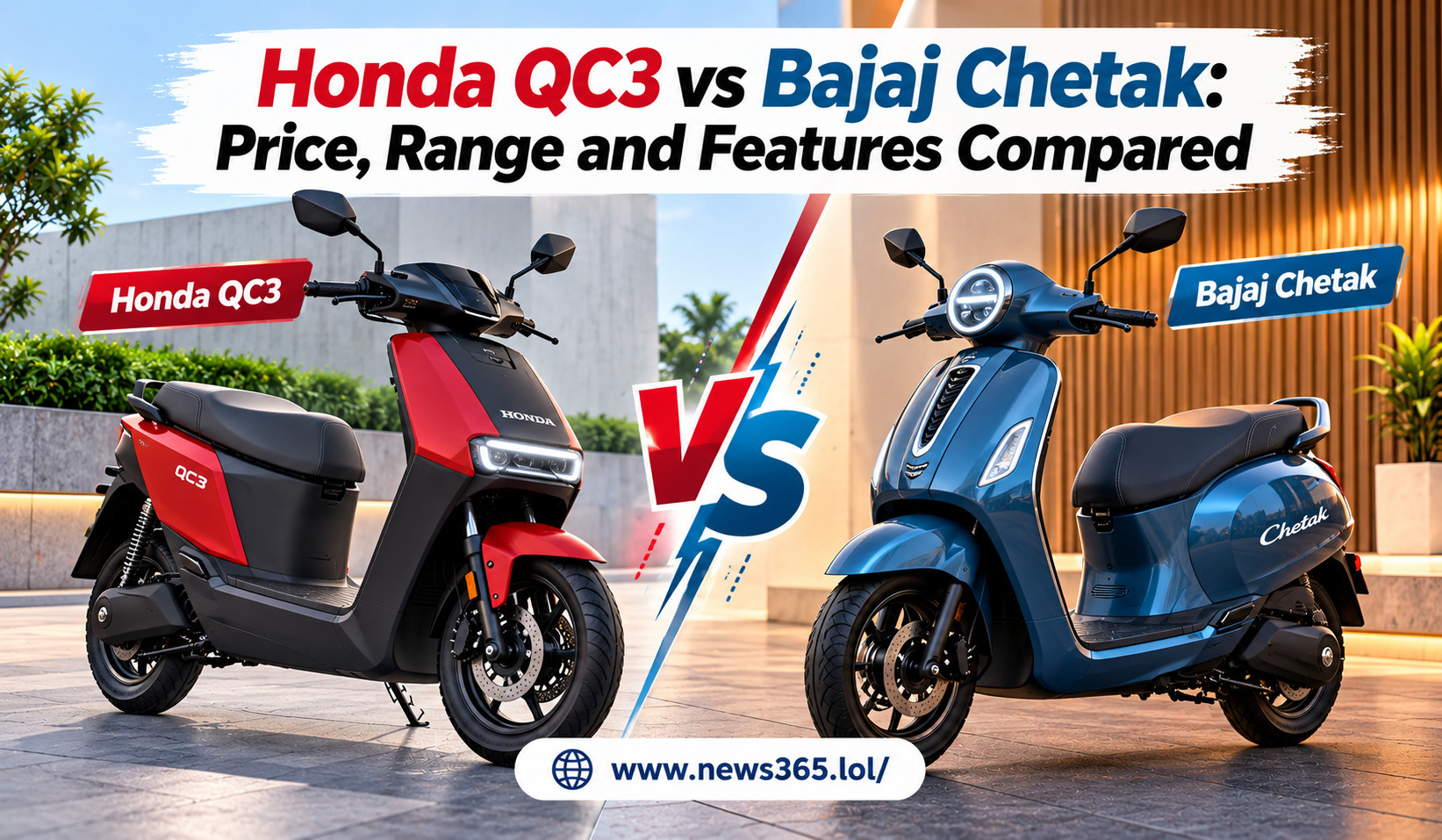
India’s electric scooter market is becoming more competitive, with established two-wheeler manufacturers introducing new models for everyday commuting. Honda and Bajaj are two major brands attracting attention in this segment. The Honda QC3 and Bajaj Chetak offer practical electric mobility, modern features and an alternative to conventional petrol scooters.
The Honda QC3 is a relatively new electric scooter featuring a 3 kWh battery, a claimed range of 145 km and a technology-focused instrument console. The Bajaj Chetak, meanwhile, has a wider variant lineup, a metal body construction, multiple battery options and a familiar design suited to everyday transportation.
For buyers planning to switch to an electric scooter, comparing the Honda QC3 vs Bajaj Chetak can help identify which model offers better value. Let’s explore their pricing, battery capacity, riding range, performance, features and practicality.
Honda QC3 vs Bajaj Chetak: Price Comparison
Price is one of the most important factors when purchasing an electric scooter. Both manufacturers have positioned their products for customers looking for convenient urban transportation, but their variant strategies are different.
The Honda QC3 is available in a single standard configuration, priced at ₹1.35 lakh (ex-showroom Delhi). It comes with a 3 kWh fixed battery and a set of connected features. Honda has initially introduced the scooter in selected Indian cities, with bookings opening for ₹5,000.
The Bajaj Chetak offers a wider selection of variants. Its lineup includes the C2501, 3001, 3503, 3502 and 3501. Depending on the configuration, prices start at approximately ₹96,400 and extend to around ₹1.34 lakh (ex-showroom).
This gives Bajaj an advantage in terms of price flexibility. Buyers can choose an entry-level model for regular city commuting or spend more on a higher battery configuration with additional features.
The Honda QC3, however, offers a straightforward purchasing option with a single battery and feature package.
Prices may vary depending on the city, dealership, registration charges, insurance and available promotional benefits. Buyers should confirm the latest on-road price before making a purchase.
Battery Capacity and Claimed Riding Range
Battery capacity and riding range are essential considerations for electric scooter buyers. They determine how frequently the scooter needs charging and whether it can handle daily commuting requirements.
The Honda QC3 comes with a 3 kWh lithium-ion battery. According to the manufacturer-related specifications published at launch, it offers a claimed IDC range of 145 km. This makes it suitable for customers who regularly travel within city limits and want to reduce charging frequency.
The Bajaj Chetak offers different battery configurations depending on the selected variant. The C2501 gets a 2.5 kWh battery with a claimed range of 113 km, while the C3001 uses a 3 kWh battery and offers approximately 127 km.
The higher Chetak variants feature a 3.5 kWh battery. Their claimed IDC ranges extend to approximately 151–153 km, depending on the version.
On paper, the Honda QC3 offers a longer claimed range than the Chetak C3001, despite both using 3 kWh battery packs. However, the higher-specification Chetak variants provide competitive range figures.
Actual riding range can differ from manufacturer claims because of traffic conditions, riding speed, passenger weight, road quality, temperature and riding mode. People who travel long distances every day should consider these factors before choosing a scooter.
Motor Performance and Top Speed
Motor performance influences acceleration, overtaking ability and overall riding convenience. It is particularly important for commuters travelling through busy roads and mixed traffic conditions.
The Honda QC3 uses a hub-mounted electric motor. Honda has highlighted its battery capacity, range and connected features, but detailed official motor power and top-speed figures have not been consistently disclosed in its launch specifications. Buyers should therefore avoid relying on unverified performance claims.
The Bajaj Chetak offers different performance specifications across its variants. The C3001 features a 3.1 kW peak-power motor with a claimed top speed of approximately 62–70 kmph, depending on the published variant specification. The higher C3501 and C3502 versions offer a claimed top speed of up to 73 kmph in the current specification listings.
The Chetak also offers different riding modes, including Eco and Sport, depending on the variant.
For everyday city commuting, both scooters are designed around practical urban mobility. However, customers interested in higher-speed performance should take a test ride and confirm the exact specifications of their preferred Chetak variant. Honda’s detailed performance figures should also be checked with an authorised dealer.
Features and Technology Compared
Modern electric scooters are increasingly equipped with digital displays, smartphone connectivity and convenience features.
The Honda QC3 offers a 5-inch TFT instrument console with Honda RoadSync connectivity. Its technology package includes turn-by-turn navigation, Bluetooth connectivity, call and message alerts, and music controls.
The scooter also features a Smart Key system, LED lighting and a USB charging port. These additions make it convenient for riders who use their smartphones regularly during daily travel.
The Bajaj Chetak offers a digital instrument console, Bluetooth connectivity and smartphone-related functions. Depending on the selected variant, customers can access call and music controls, navigation-related functions and additional connected features.
Higher-specification Chetak variants provide a more extensive equipment package, including touchscreen functionality on supported models.
Both scooters offer useful technology, but the Honda QC3 stands out with its 5-inch TFT display and Honda RoadSync integration. Bajaj provides more variation across its lineup, allowing buyers to select a feature package according to their budget.
Design, Comfort and Everyday Practicality
Design and comfort are important for people who use electric scooters for office travel, shopping and household requirements.
The Honda QC3 features a contemporary design with an apron-mounted LED headlamp, clean body panels and an upright riding position. Its long single-piece seat is designed for everyday usability.
One of its important practical highlights is the 32-litre under-seat storage capacity. This provides sufficient space for carrying everyday belongings, shopping items and other essentials.
The Bajaj Chetak follows a more familiar scooter design inspired by the original Chetak styling. Its metal body construction is one of its major highlights, giving it a distinctive identity in the electric scooter segment.
The Chetak also offers generous storage space. Depending on the variant, under-seat storage can reach approximately 35 litres, providing an advantage for customers who frequently carry bags and personal belongings.
For families and regular commuters, both scooters offer practical seating arrangements and everyday convenience. However, buyers should check seat comfort, pillion space and suspension performance during a physical test ride.
Charging Time and Ownership Experience
Charging convenience is another important factor when selecting an electric scooter.
The Honda QC3 comes with a 3 kWh battery that takes approximately four hours for a complete charge. Honda also claims that the battery can reach 80% charge in around two hours and 40 minutes under the specified charging conditions.
The Bajaj Chetak’s charging duration varies according to the selected battery configuration and charger. For example, the C3501 is listed with a full charging time of approximately three hours, while other versions have different charging requirements.
Both scooters can be considered for home charging, but customers should confirm the supplied charger specifications and installation requirements before purchasing.
Ownership support also matters. Honda benefits from its established two-wheeler service network, although QC3 availability is initially limited to selected dealerships. Bajaj has an established Chetak dealership and service ecosystem across several Indian cities.
Before making a final decision, check authorised service centre availability, battery warranty, roadside assistance and spare-parts support in your area.
Which Electric Scooter Should You Choose?
The Honda QC3 and Bajaj Chetak cater to customers with slightly different priorities.
The Honda QC3 is worth considering if you want a modern electric scooter with a 3 kWh battery, a claimed 145 km range, a TFT display and Honda RoadSync connectivity. Its straightforward variant structure may also appeal to buyers who prefer a simple purchasing decision.
The Bajaj Chetak is a strong option if you want more battery configurations, different price points and the familiarity of an established electric scooter lineup. Its metal body, larger storage capacity on selected variants and multiple performance options make it suitable for different commuting requirements.
For budget-conscious buyers, the entry-level Chetak offers a lower starting price. For customers comparing the QC3 with the Chetak C3001, Honda offers a higher claimed range, while Bajaj provides a more affordable alternative.
Conclusion
The Honda QC3 vs Bajaj Chetak comparison highlights two different approaches to electric mobility in India. Honda focuses on a straightforward battery configuration, connected technology and a claimed 145 km range. Bajaj offers a wider product lineup with multiple battery capacities, different price points and a familiar metal-body design.
The Honda QC3 is an interesting option for buyers who prioritise its TFT display, RoadSync connectivity and claimed riding range. Meanwhile, the Bajaj Chetak stands out for its affordability, variant flexibility and practical everyday features.
Ultimately, the better electric scooter depends on your budget, daily commuting distance, preferred technology and local service availability. Comparing the latest prices and taking test rides can help you choose the right model for your requirements.