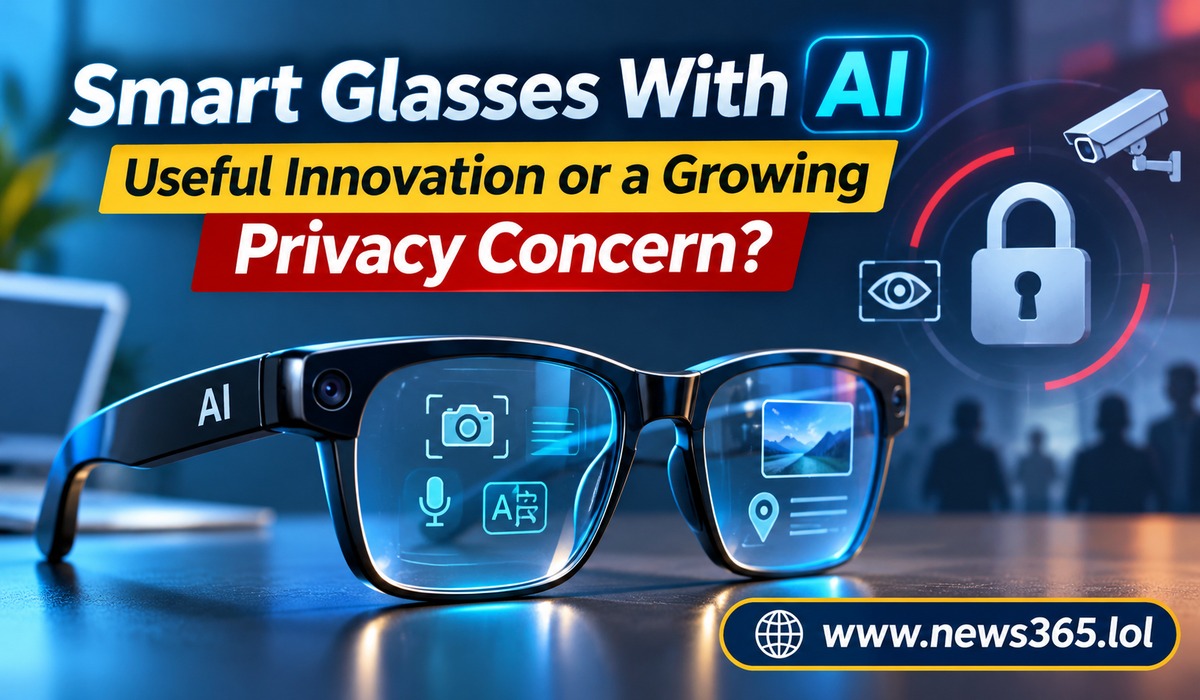
Technology is changing the way people interact with the world. Smartphones, smartwatches, wireless headphones, and voice assistants have already become part of everyday life. Now, another technology is attracting attention: AI-powered smart glasses. These glasses look similar to regular eyewear but come with built-in cameras, microphones, speakers, and artificial intelligence features.
Smart glasses can help users take pictures, record videos, answer questions, listen to music, receive directions, and communicate without taking out their phones. Some models can even recognise objects, translate conversations, and provide information about things users are looking at.
Although these features sound exciting, they also raise an important question. Are AI smart glasses making everyday life easier, or are they creating new privacy problems?
The answer is not simple. Smart glasses offer several practical benefits, but their ability to record and process information about people and surroundings requires careful attention. Understanding both sides can help consumers decide whether this technology is worth adopting.
What Are AI-Powered Smart Glasses?
AI-powered smart glasses are wearable devices that combine traditional eyewear with digital technology. They may look like ordinary glasses, but small electronic components are built into their frames.
Depending on the model, they can include cameras, microphones, speakers, wireless connections, and voice controls. Some advanced versions also include small displays that show digital information directly in front of the user’s eyes.
Artificial intelligence makes these glasses more useful than simple recording devices. Instead of only capturing pictures or playing music, they can understand certain voice requests and help users complete everyday tasks.
For example, someone visiting a new city could ask the glasses for directions. A traveller could use translation features to understand a conversation in another language. A student might ask a question about an object in front of them and receive an explanation.
The main idea is to make technology available without requiring users to hold a smartphone in their hands.
How Are Smart Glasses Changing Everyday Life?
One of the biggest advantages of AI smart glasses is convenience. People regularly use their phones to check information, take pictures, send messages, and search for answers. Smart glasses can make some of these activities easier.
Users can take photos or record short videos while keeping their hands free. This can be useful when travelling, cycling in suitable conditions, attending events, or working on tasks that require both hands.
Voice assistance is another useful feature. Instead of opening an application and typing a question, users can speak directly to their glasses. The built-in assistant can respond through small speakers or another supported display.
Smart glasses can also provide directions while walking. This may reduce the need to look down at a phone repeatedly. Some models offer translation features that help people communicate when they are travelling abroad.
For people who need additional assistance, these devices may offer further benefits. For example, audio descriptions of nearby objects could help some users with visual difficulties understand their surroundings.
However, the usefulness of these features depends on the device, its software, internet access, and the quality of its AI system.
The Benefits of AI Smart Glasses
Hands-Free Convenience
Smart glasses allow users to access selected digital features without holding a phone. This can make everyday activities more comfortable.
A person cooking can ask for a measurement conversion without touching a screen. A traveller can capture a photograph without taking a phone out of a pocket. Someone working with tools may be able to receive spoken instructions while keeping their hands available.
This convenience is one of the strongest reasons why consumers may become interested in smart glasses.
Better Travel Experiences
Travelling often involves checking maps, translating languages, taking photographs, and searching for information about unfamiliar places.
AI smart glasses could make these activities easier. A user might ask for information about a nearby building, receive directions, or translate selected text while exploring a new destination.
These features could be particularly helpful for international travellers who want quick information without constantly checking their smartphones.
Support for Learning
Smart glasses may also become useful learning tools. Students could ask questions about objects, receive explanations, or access information while exploring educational locations.
For example, someone visiting a museum might use an AI assistant to learn more about an exhibition. A student studying plants could ask for information about a particular species.
These tools should support learning rather than replace teachers, books, or proper research. AI-generated information can sometimes be incomplete or incorrect, so important facts should still be checked.
Improved Workplace Productivity
Some industries may benefit from hands-free access to information. Workers in warehouses, manufacturing facilities, and technical services could receive instructions while completing practical tasks.
A technician might use compatible smart glasses to view repair guidance. A warehouse employee could receive information about a product without repeatedly checking a handheld device.
Businesses may also explore these devices for training and remote assistance. An experienced worker could guide another employee by viewing information shared through a supported system.
Accessibility Support
AI smart glasses could provide additional independence to people who face certain accessibility challenges.
Audio descriptions, spoken directions, and voice-based controls may help users interact with their surroundings. Translation and speech assistance may also make communication easier in some situations.
However, these devices should not be presented as a complete replacement for established accessibility equipment. Their reliability and suitability depend on individual needs.
The Growing Privacy Concerns Around AI Smart Glasses
Despite their advantages, smart glasses create serious questions about personal privacy. The biggest concern is their ability to record people without making it obvious.
Recording People Without Their Knowledge
Traditional cameras and smartphones are usually easy to recognise. When someone takes out a phone and points its camera towards another person, people can often notice that they are being recorded.
Smart glasses make this situation different. Their cameras are built into ordinary-looking frames. Someone wearing them may be able to take photographs or record videos without clearly showing that a camera is being used.
This creates problems in public places, offices, restaurants, shopping centres, and other shared spaces. People may unknowingly appear in videos that are later uploaded to social media.
A person should have a reasonable opportunity to know when their image or voice is being recorded. Without that awareness, it becomes difficult to make an informed choice about personal privacy.
Collection of Personal Information
AI smart glasses may collect more than photographs and videos. Depending on their features, they can also process voice recordings, location information, and details about nearby surroundings.
This information may be connected to an account or stored through a companion smartphone application. Some AI services also process information through online systems.
The concern is what happens after the information is collected. Users may not always understand how long their recordings are stored, who can access them, or whether information is used to improve AI services.
Companies must explain these practices clearly. Consumers should not have to guess what happens to their personal information after using a device.
Risks of Unwanted Sharing
Another concern is the sharing of private moments on social media.
Someone wearing smart glasses could record a conversation, a stranger’s reaction, or an everyday activity and upload it online. Even if the recording seems harmless to the person sharing it, the individual appearing in the video may feel uncomfortable.
Once a video becomes public, controlling its spread can be difficult. Other users may download it, share it, or use it in ways the original person never expected.
This is particularly concerning when children, employees, customers, or people in vulnerable situations appear in recordings.
Security and Data Misuse
Like other connected devices, smart glasses can face security problems. Weak passwords, unsafe applications, software weaknesses, or poorly protected accounts may expose personal information.
If someone gains access to an account or stored recordings, private images and conversations could be misused.
There is also concern about who reviews information when users interact with AI services. Consumers should understand whether recordings are processed automatically, stored online, or reviewed by people under specific service arrangements.
Privacy protection should be an important part of the product, not something companies consider only after a problem occurs.
Are Technology Companies Taking Privacy Seriously?
Technology companies have started introducing privacy features to address some of these concerns. Certain smart glasses include small indicator lights that turn on when the camera is recording.
These lights are intended to alert nearby people that recording is taking place. Some devices also provide settings that allow users to control recording, manage saved content, and review privacy permissions.
However, these protections are not always enough. A small light may be difficult to notice, particularly in bright surroundings. People who have never seen smart glasses before may not understand what the indicator means.
Privacy organisations are also asking technology companies to provide clearer warnings and stronger protections. In October 2026, the European Data Protection Board published a statement highlighting the privacy challenges associated with smart glasses, including recording without people’s knowledge and the handling of personal information.
This shows that privacy is becoming an important part of the discussion around wearable AI technology.
Companies need to build products that respect both the person wearing the glasses and the people around them.
How Can Users Protect Their Privacy?
Consumers do not need to avoid smart glasses completely, but they should understand how these devices work before purchasing them.
Reading the privacy policy is a useful starting point. Users should check what information the glasses collect, where recordings are stored, and whether the company shares information with other service providers.
It is also important to review the settings available in the connected smartphone application. Camera access, microphone permissions, location sharing, and cloud storage should be controlled according to personal needs.
Users should avoid recording private conversations or taking photographs of people without appropriate permission. They should also respect restrictions in places such as hospitals, schools, changing rooms, and private workplaces.
Keeping the device software updated can help reduce security risks. Strong account passwords and additional account protection can also make unauthorised access more difficult.
Most importantly, users should remember that having the technical ability to record something does not automatically mean they should do so.
What Should Consumers Check Before Buying AI Smart Glasses?
Before buying smart glasses, consumers should look beyond appearance and advertised AI features.
They should understand whether the device offers a camera, microphone, display, voice assistant, or online AI services. Not every model provides the same functions.
Battery life is another important consideration. Features such as video recording, voice assistance, and wireless connections can affect how long the glasses operate before needing a recharge.
Comfort also matters. Since these devices are designed to be worn for extended periods, their weight, frame design, lens quality, and fit should be suitable for everyday use.
Privacy controls deserve equal attention. Buyers should check whether recording indicators are clearly visible, whether recordings can be deleted easily, and whether important features work without uploading unnecessary personal information.
The best product is not necessarily the one with the most advanced features. It is the one that offers useful functions while providing reasonable control over personal data.
The Future of AI-Powered Smart Glasses
AI smart glasses are still developing, and their future will depend on how technology companies respond to consumer needs.
Future models may offer better translation, improved voice assistance, longer battery life, and more accurate information about surroundings. Some devices may also include improved displays that allow users to access useful information without looking at a smartphone.
Privacy protection will also need to improve. More information could be processed directly on the device instead of being sent to online services. Clear recording indicators, stronger security, and easier privacy controls could make these products more acceptable to the public.
Governments and privacy organisations may also introduce clearer rules about recording, storing, and sharing information through wearable devices.
However, technology alone cannot solve every problem. Responsible behaviour from users and clear policies from manufacturers will remain important.
If companies ignore privacy concerns, people may become uncomfortable wearing these devices or interacting with someone who uses them.
Conclusion
AI-powered smart glasses are an interesting development in modern technology. They offer hands-free convenience, useful travel features, learning support, and new ways to interact with digital information.
At the same time, their cameras, microphones, and AI features create genuine privacy concerns. Recording people without their knowledge, collecting personal information, and sharing private moments can affect individuals who never agreed to use these devices.
Smart glasses should not be judged only by how advanced their technology is. Their ability to protect users and the people around them is equally important.
Ultimately, AI smart glasses can become a useful innovation if companies develop stronger privacy protections and consumers use them responsibly. The goal should be to make everyday life easier without making personal privacy harder to protect.
Frequently Asked Questions
1. What are AI smart glasses used for?
AI smart glasses are used for taking photographs, recording videos, listening to music, receiving directions, translating languages, and asking questions through voice assistants. Features depend on the model.
2. Can AI smart glasses record people without their knowledge?
Yes. Some models have built-in cameras that can record videos or take photographs without the wearer holding a phone. Recording indicators may provide warnings, but nearby people can sometimes miss them.
3. Are AI smart glasses safe for personal privacy?
They can be used responsibly, but privacy depends on their security features, recording controls, data storage practices, and how users handle personal information.
4. Can AI smart glasses collect personal information?
Yes. Depending on the device, they may collect photographs, videos, voice recordings, location information, and other data processed through connected applications and AI services.
5. Are AI smart glasses worth buying?
They may be worth buying for people who want hands-free photography, voice assistance, translation, or other useful features. However, buyers should carefully check battery life, comfort, privacy settings, and data protection before making a decision.